
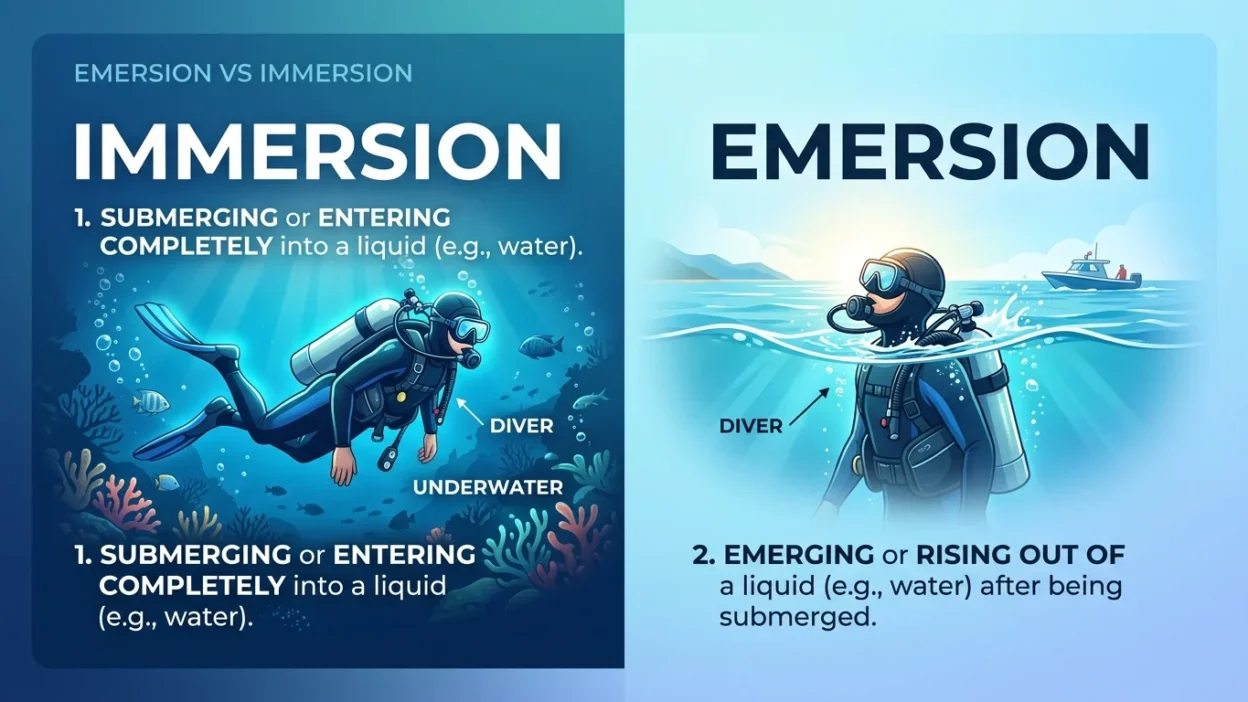
The words emersion and immersion look almost identical, but they carry opposite meanings. That’s why they’re easy to confuse especially in writing about learning, science, or water-related contexts. Choosing the wrong one can flip your sentence’s meaning completely.
In this guide, you’ll learn the difference between emersion vs immersion, when to use each word, real examples, common mistakes, and an easy trick to remember them. By the end, you’ll feel confident using both correctly.
Quick Answer: Emersion vs Immersion
- Immersion = being submerged in or deeply involved in something
- Emersion = coming out of a liquid or emerging
- Immersion is common in everyday English
- Emersion is rare and mostly technical
Example:
- Language immersion helps you learn faster.
- The diver’s emersion was delayed.
What Does “Immersion” Mean?
Immersion refers to being fully submerged in liquid or deeply involved in an activity, environment, or experience. It’s commonly used in education, technology, learning, and water-related contexts.
You’ll often see immersion in phrases like:
- Language immersion
- Full immersion
- Cultural immersion
- Water immersion
- Immersive experience
Examples of “Immersion” in Sentences
- She learned Spanish through immersion.
- The phone supports full water immersion.
- The program offers cultural immersion.
- Virtual reality creates total immersion.
- The diver prepared for deep immersion.
In each case, immersion means being fully involved or submerged.
When to Use “Immersion”
Use immersion when referring to:
- Being underwater
- Deep involvement
- Learning through exposure
- Engaging experiences
- Full participation
Think: Immersion = In
What Does “Emersion” Mean?
Emersion means coming out of a liquid or emerging from submersion. It’s the opposite of immersion. This word is mostly used in scientific, biological, and technical contexts.
You’ll see emersion in:
- Marine biology
- Diving terminology
- Astronomy
- Environmental science
- Tidal studies
Examples of “Emersion” in Sentences
- The whale’s emersion was brief.
- The diver’s emersion was slow and controlled.
- Tidal emersion exposed the rocks.
- The satellite’s emersion occurred at sunrise.
- The submarine’s emersion followed the test.
Here, emersion refers to coming out of water or submersion.
When to Use “Emersion”
Use emersion when talking about:
- Coming out of water
- Rising to the surface
- Emerging from submersion
- Scientific observations
- Tidal exposure
Think: Emersion = Exit
Emersion vs Immersion: Side by Side Comparison
| Feature | Immersion | Emersion |
|---|---|---|
| Meaning | Being submerged | Coming out of submersion |
| Direction | Going in | Coming out |
| Usage frequency | Very common | Rare |
| Context | Learning, water, tech | Science, diving |
| Example | Language immersion | Diver emersion |
| Memory trick | Immersion = In | Emersion = Exit |
Common Mistakes People Make
Mistake 1: Using “Emersion” Instead of “Immersion”
Incorrect: Language emersion improves fluency.
Correct: Language immersion improves fluency.
Why? You’re talking about deep involvement, not coming out.
Mistake 2: Using “Immersion” for Coming Out of Water
Incorrect: The diver’s immersion happened after 10 minutes.
Correct: The diver’s emersion happened after 10 minutes.
Why? The diver is emerging, not going in.
Mistake 3: Assuming They’re Interchangeable
They are not synonyms they’re actually opposites.
Easy Trick to Remember the Difference
Use this simple memory trick:
- Immersion = In
- Emersion = Exit
Another helpful trick:
- Im = Into
- E = Exit
This quick check helps you choose the correct word instantly.
Real Life Usage Examples
Learning Context
- The school uses language immersion.
- Students return after full cultural immersion.
(Emersion would not be used here.)
Diving Context
- The diver began immersion at noon.
- The diver’s emersion happened later.
Technology Context
- The headset offers full immersion.
- VR aims to maximize immersion.
Nature Context
- Low tide caused rock emersion.
- Water immersion damaged the device.
American vs British English
There is no spelling difference between American and British English for emersion and immersion. Both are spelled the same.
However:
- Immersion is widely used in both regions
- Emersion is rare in everyday conversation
Most people will encounter immersion far more often.
Synonyms for Immersion
Depending on context:
- Submersion
- Deep involvement
- Engagement
- Absorption
- Total exposure
- Participation
- Envelopment
Example:
Cultural immersion → Cultural engagement
Synonyms for Emersion
Depending on context:
- Emergence
- Surfacing
- Rising
- Appearance
- Coming out
- Exposure
Example:
Diver emersion → Diver surfacing
Grammar Note
Immersion
- Noun
- Commonly used
- Works in both literal and figurative contexts
Example: Language immersion works well.
Emersion
- Noun
- Rare usage
- Mostly technical
Example: The whale’s emersion was brief.
Frequently Asked Questions
Is emersion the opposite of immersion?
Yes. Emersion means coming out, while immersion means going in.
Which is more common: immersion or emersion?
Immersion is far more common in everyday English.
What is language immersion?
Language immersion is learning by surrounding yourself fully with a language.
Is emersion used in everyday conversation?
Rarely. It’s mostly used in scientific or technical writing.
Can immersion be figurative?
Yes. It can mean deep involvement, not just physical submersion.
What does emersion mean in science?
It refers to emerging from water or becoming exposed.
Is immersion always about water?
No. It can refer to learning, VR, culture, and experiences.
How do I remember emersion vs immersion?
Immersion = In
Emersion = Exit
Summary:
The difference between emersion vs immersion comes down to direction. Immersion means going into something like water, culture, or an experience. It suggests deep involvement, full exposure, or complete submersion. Emersion, on the other hand, means coming out of something, usually water. It’s the opposite of immersion and is used mostly in technical contexts.
Most of the time, you’ll need immersion, especially in everyday writing about learning, VR, or experiences. Use emersion only when describing something emerging from water or submersion. Keeping the In vs Exit rule in mind makes choosing the right word simple.
Actionable takeaway:
Ask yourself: Is something going in or coming out? If going in, use immersion. If coming out, use emersion.