
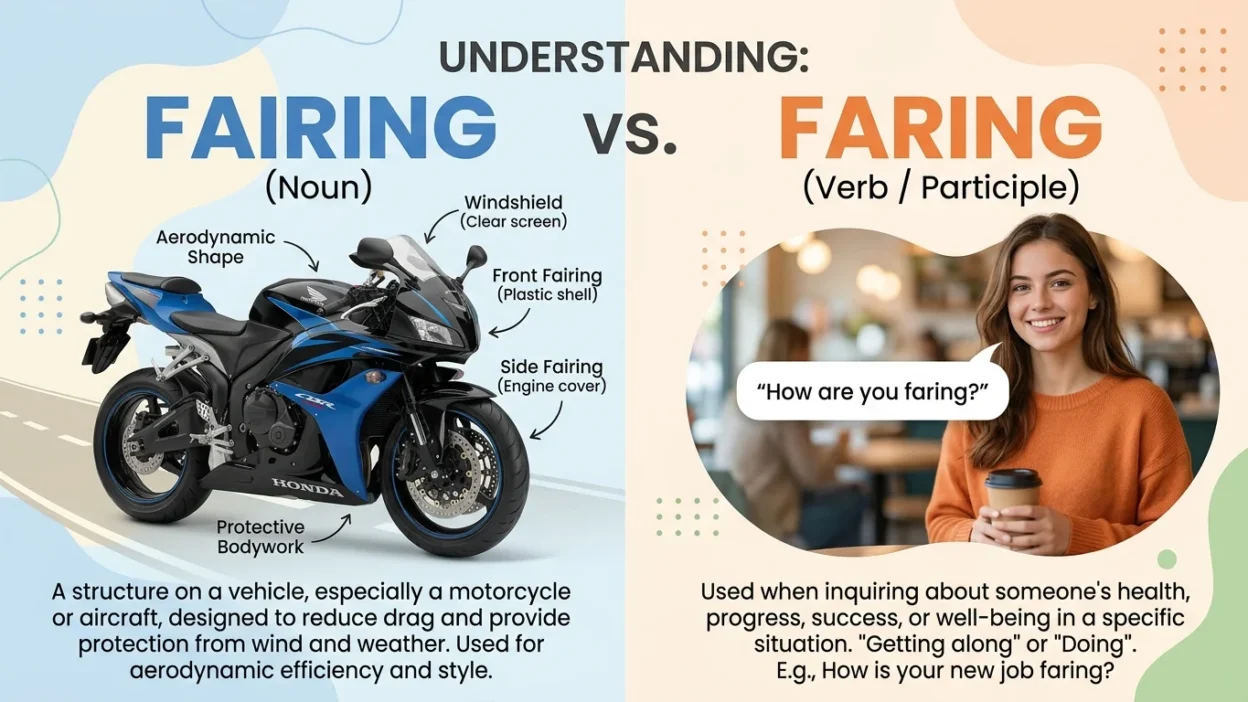
Confused about fairing or faring? You’re not alone. These two words sound exactly the same, but they mean completely different things. One relates to aerodynamics and vehicle parts, while the other is about how someone is doing or getting along. Using the wrong one can make your sentence confusing or even incorrect.
In this guide, you’ll learn the difference between fairing vs faring, when to use each word, common mistakes to avoid, and simple examples that make everything crystal clear. By the end, you’ll never mix them up again.
Quick Answer: Fairing or Faring
- Fairing = a structure that improves aerodynamics (motorcycles, aircraft, rockets)
- Faring = how someone is doing or managing (from the verb “fare”)
- Fairing is usually a noun
- Faring is usually a verb form
Example:
- The motorcycle has a new fairing.
- How are you faring today?
What Does “Fairing” Mean?
Fairing refers to a protective or aerodynamic structure added to vehicles like motorcycles, airplanes, rockets, or boats. Its purpose is to reduce air resistance, improve speed, and sometimes protect internal components.
You’ll most often see fairing in technical, automotive, and aviation contexts.
Common Uses of Fairing
- Motorcycle body panels
- Aircraft nose fairing
- Rocket fairing (payload fairing)
- Boat fairing structures
- Bicycle aerodynamic fairing
Examples of “Fairing” in Sentences
- The motorcycle’s fairing reduced wind resistance.
- Engineers designed a new rocket fairing.
- The damaged fairing needed replacement.
- The bike has a full front fairing.
- The aircraft nose fairing protects internal equipment.
In each case, fairing refers to a physical component.
When to Use “Fairing”
Use fairing when talking about:
- Aerodynamic parts
- Vehicle body panels
- Protective shells
- Streamlined structures
- Engineering components
Think: Fairing = Physical part
What Does “Faring” Mean?
Faring comes from the verb fare, meaning to get along, manage, or do in a certain situation. It’s commonly used when asking about someone’s condition or progress.
You’ll usually see faring in questions or discussions about how things are going.
Examples of “Faring” in Sentences
- How are you faring after the move?
- The team is faring well this season.
- She’s faring better than expected.
- How is your project faring?
- The company is faring poorly in the market.
Here, faring refers to performance or condition, not a physical object.
When to Use “Faring”
Use faring when referring to:
- How someone is doing
- Progress in a situation
- Performance or results
- Managing challenges
- Emotional or physical condition
Think: Faring = Doing
Fairing vs Faring: Side-by-Side Comparison
| Feature | Fairing | Faring |
|---|---|---|
| Meaning | Aerodynamic structure | How someone is doing |
| Part of speech | Noun | Verb (present participle) |
| Context | Vehicles, engineering | Performance, condition |
| Example | Rocket fairing | How are you faring? |
| Usage type | Physical object | Action/state |
| Memory trick | Fairing = machine part | Faring = doing |
Common Mistakes People Make
Mistake 1: Using “Fairing” Instead of “Faring”
Incorrect: How are you fairing today?
Correct: How are you faring today?
Why? You’re asking about someone’s condition, not a vehicle part.
Mistake 2: Using “Faring” for Vehicle Parts
Incorrect: The motorcycle’s faring was damaged.
Correct: The motorcycle’s fairing was damaged.
Why? A bike has a fairing, not faring.
Mistake 3: Spellcheck Doesn’t Catch It
Both words are spelled correctly, so grammar tools may not flag the mistake. Always check meaning.
Easy Trick to Remember the Difference
Use this quick memory trick:
- Fairing = Fair + ing → vehicle part
- Faring = Fare → how you’re doing
Or even simpler:
- Fairing = Thing
- Faring = Doing
Real Life Usage Examples
Motorcycle Context
- The new fairing improved aerodynamics.
- Riders are faring better in windy conditions.
Aviation Context
- The rocket fairing opened successfully.
- The mission is faring well so far.
Everyday Conversation
- How are you faring this week?
- The bike’s fairing looks sleek.
Business Context
- The company is faring well financially.
- The aircraft fairing was redesigned.
American vs British English
There is no spelling difference between American and British English for fairing and faring. Both are spelled the same worldwide.
However:
- Fairing is more common in technical engineering discussions
- Faring appears more in conversational English
Both are equally correct in US and UK English.
Synonyms for Fairing
Depending on context, fairing may be similar to:
- Panel
- Shell
- Cover
- Housing
- Bodywork
- Aerodynamic cover
- Streamlining panel
Example:
The bike’s fairing → The bike’s body panel
Synonyms for Faring
Depending on context, faring may be similar to:
- Doing
- Managing
- Coping
- Performing
- Getting along
- Progressing
- Handling
Example:
She is faring well → She is doing well
Grammar Note
Fairing
- Noun
- Refers to an object
- Usually preceded by “a” or “the”
Example: The fairing was removed.
Faring
- Present participle verb
- Describes an action or state
Example: He is faring well.
This grammar difference helps identify which word you need.
Frequently Asked Questions
Is it fairing or faring well?
Correct: Faring well
Because you’re describing how someone is doing.
What is a motorcycle fairing?
A motorcycle fairing is an aerodynamic panel that reduces wind resistance and protects the rider.
How are you fairing or faring?
Correct: How are you faring?
You’re asking about someone’s condition.
Is fairing used in aviation?
Yes. Aircraft and rockets use fairings to improve aerodynamics and protect components.
Can faring be used as a noun?
No. Faring is typically a verb form, not a noun.
Why are fairing and faring confused?
They are homophones words that sound the same but have different meanings.
Which is more common in daily English?
Faring appears more in everyday conversation.
Is “fairing” technical vocabulary?
Yes, it’s mostly used in engineering, vehicles, and aviation.
Summary:
The difference between fairing or faring comes down to object versus condition. Fairing refers to a physical aerodynamic structure used on vehicles, motorcycles, aircraft, and rockets. It improves airflow, protects components, and enhances performance. Meanwhile, faring describes how someone or something is doing, progressing, or managing in a situation.
Understanding this distinction makes your writing clearer and more professional. If you’re talking about a vehicle part, use fairing. If you’re asking how someone is doing, use faring. This simple rule prevents one of the most common homophone mistakes in English.
Actionable takeaway:
Before choosing between fairing and faring, ask yourself: Am I talking about a machine part or how someone is doing? If it’s a part, use fairing. If it’s about condition or progress, use faring.