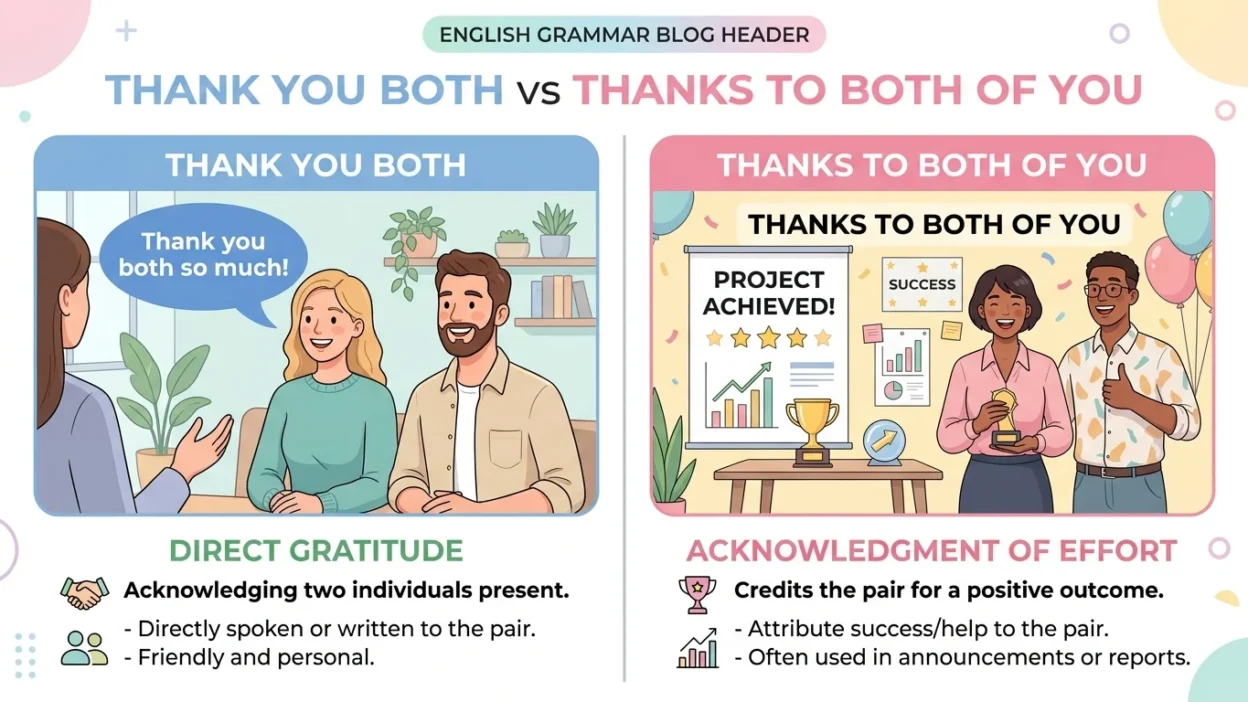
The phrases thank you both and thanks to both of you look similar, but they’re used in different situations. One is used to express gratitude directly, while the other often explains who deserves credit. Choosing the right phrase helps your message sound more natural and polite.
This guide explains thank you both vs thanks to both of you, meanings, examples, differences, and when to use each correctly.
Quick Answer: Thank You Both vs Thanks to Both of You
- Thank you both → direct gratitude to two people
- Thanks to both of you → giving credit or explaining cause
- Both are correct but used differently
Example:
- Thank you both for helping me.
- Thanks to both of you, we finished early.
What Does “Thank You Both” Mean?
Thank you both is a direct expression of gratitude to two people. It’s simple, natural, and commonly used in conversations, emails, and messages.
You use thank you both when:
- Speaking directly to two people
- Showing appreciation
- Ending a message politely
- Being warm and personal
Examples of “Thank You Both”
- Thank you both for your help.
- Thank you both for coming.
- Thank you both for supporting me.
- Thank you both I appreciate it.
- Thank you both for the gift.
This phrase sounds friendly and direct.
What Does “Thanks to Both of You” Mean?
Thanks to both of you usually means because of you two or credit goes to you two. It’s often used to explain why something happened successfully.
You use thanks to both of you when:
- Giving credit
- Explaining success
- Showing cause/result
- Writing more formally
Examples of “Thanks to Both of You”
- Thanks to both of you, the project succeeded.
- We finished early thanks to both of you.
- Thanks to both of you, everything worked out.
- The event was great thanks to both of you.
- Thanks to both of you, we solved the problem.
This phrase emphasizes result, not just gratitude.
Thank You Both vs Thanks to Both of You: Comparison Table
| Feature | Thank You Both | Thanks to Both of You |
|---|---|---|
| Purpose | Express gratitude | Give credit |
| Tone | Direct and personal | Slightly formal |
| Meaning | I appreciate you | Because of you |
| Usage | Conversation | Explanation |
| Example | Thank you both | Thanks to both of you, we won |
Key Difference in Meaning
These phrases are not always interchangeable.
Thank you both for helping.
→ Direct appreciation
Thanks to both of you, we finished early.
→ You caused the success
One thanks people. The other explains why something happened.
When Both Can Work
Sometimes both are correct but slightly different.
Thank you both for your support.
→ Expressing gratitude
Thanks to both of you, I felt supported.
→ Explaining result
The difference is subtle but important.
Which One Sounds More Natural?
In most everyday situations:
- Thank you both sounds more natural
- Thanks to both of you sounds slightly formal
Example:
Natural: Thank you both!
Less common: Thanks to both of you!
Common Mistakes People Make
Mistake 1: Using “Thanks to” for Direct Gratitude
Less natural: Thanks to both of you!
Better: Thank you both!
Mistake 2: Using “Thank You Both” in Cause Sentences
Incorrect: Thank you both, we finished early.
Better: Thanks to both of you, we finished early.
Mistake 3: Mixing Both Incorrectly
Incorrect: Thank you to both of you for the success.
Better:
- Thank you both for your help.
OR - Thanks to both of you, we succeeded.
Tone Differences
Thank you both
- Friendly
- Warm
- Casual
- Direct
Thanks to both of you
- Slightly formal
- Explanatory
- Emphasizes result
- Used in writing
Real Life Examples
Workplace
- Thank you both for your contributions.
- Thanks to both of you, the deadline was met.
Friends
- Thank you both for coming.
- Thanks to both of you, the party was fun.
- Thank you both for your time.
- Thanks to both of you, the meeting went smoothly.
School
- Thank you both for helping me study.
- Thanks to both of you, I passed the exam.
American vs British English
There is no difference between American and British English. Both phrases are correct and used the same way.
- Thank you both ✅
- Thanks to both of you ✅
Both are natural worldwide.
Similar Alternatives
You can also say:
- Thank you to both of you
- Thanks, both of you
- I appreciate you both
- Many thanks to both of you
- I’m grateful to both of you
Examples:
- I appreciate you both.
- Many thanks to both of you.
Frequently Asked Questions
Is thank you both correct?
Yes. It’s a correct and common phrase.
Is thanks to both of you correct?
Yes. It’s used to give credit or show cause.
Which is more natural?
Thank you both is more natural in conversation.
Can I use them interchangeably?
Sometimes, but meanings are slightly different.
Is thank you both formal?
It can be formal or informal depending on context.
Is thanks to both of you polite?
Yes. It’s polite and slightly more formal.
Which is better in email?
Both work, but thank you both is more common.
What’s the simplest option?
Use thank you both in most cases.
Summary:
The difference between thank you both vs thanks to both of you comes down to purpose. Thank you both is used to directly express gratitude to two people. It’s simple, warm, and natural in everyday conversation. Thanks to both of you is used to give credit or explain that something happened because of those two people.
In most situations, thank you both is the safer and more natural choice. Use thanks to both of you when you want to highlight the result or cause. Understanding this small difference helps your communication sound clearer and more natural.
Actionable takeaway:
Use thank you both for direct gratitude. Use thanks to both of you when giving credit for a result.