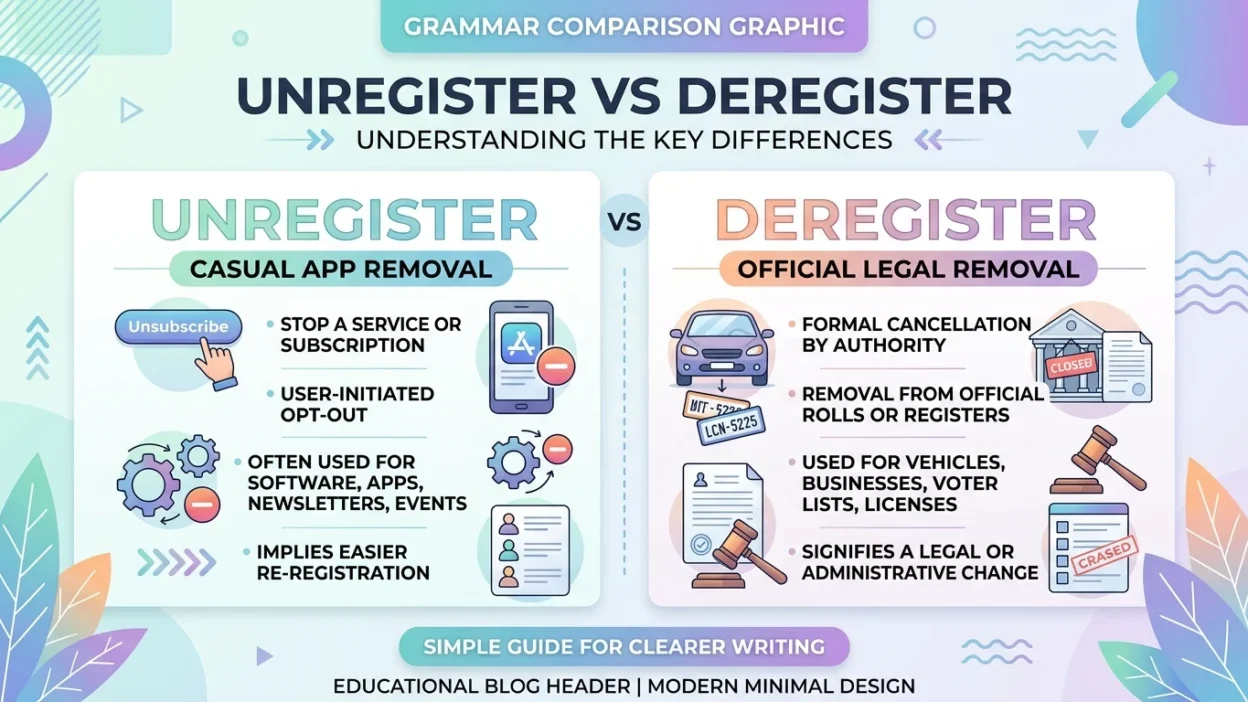
If you’re deciding between unregister and deregister, here’s the honest answer: both are correct, but they’re used in slightly different contexts. Choosing the right one depends on tone, formality, and the situation.
Let’s make it simple so you can use each word with confidence.
Quick Answer: Unregister vs Deregister
- Unregister → remove registration (general, everyday use)
- Deregister → officially remove from a register (formal/legal use)
- Both are correct, but deregister is more formal
Example:
- Please unregister your device.
- The company was deregistered by authorities.
What Does “Unregister” Mean?
Unregister means to remove something from a system, list, or registration, often in everyday or technical contexts.
Common Uses of “Unregister”
- Unregister a device
- Unregister from a service
- Unregister an account
Examples of “Unregister”
- You can unregister your email anytime.
- Please unregister this device from the system.
- He forgot to unregister from the course.
- The app allows you to unregister easily.
Think: unregister = remove casually
What Does “Deregister” Mean?
Deregister means to officially remove something from a formal register, often used in legal, government, or business contexts.
Common Uses of “Deregister”
- Deregister a company
- Deregister a vehicle
- Deregister a business
Examples of “Deregister”
- The company was deregistered last year.
- You must deregister the vehicle before selling it.
- The authority decided to deregister the organization.
Think: deregister = official removal
Unregister vs Deregister Comparison
| Word | Meaning | Context | Tone |
|---|---|---|---|
| Unregister | Remove from a system | Apps, accounts, general use | Informal to neutral |
| Deregister | Official removal | Legal, government, business | Formal |
Key Difference Explained Simply
- Unregister = everyday removal
- Deregister = official/legal removal
Example:
- I unregistered from the website.
- The government deregistered the company.
Easy Trick to Remember
Use this simple trick:
👉 Un = undo (casual removal)
👉 De = official removal
Common Mistakes People Make
Mistake 1: Using “Unregister” in Legal Contexts
Incorrect: The company was unregistered by the government.
Better: The company was deregistered.
Mistake 2: Using “Deregister” in Casual Contexts
Too formal: I want to deregister from this app.
Better: I want to unregister from this app.
Mistake 3: Assuming Only One Is Correct
Both are correct context matters.
Real Life Examples
Technology
- You can unregister your device.
Business
- The firm was deregistered due to violations.
Everyday Use
- I unregistered from the newsletter.
Legal Context
- The vehicle must be deregistered before export.
American vs British English
There is no major difference:
- Unregister ✅
- Deregister ✅
Both are used in American and British English, though deregister is more common in formal British usage.
Related Words
- Register
- Registration
- Deactivate
- Remove
Frequently Asked Questions
Which is correct unregister or deregister?
Both are correct depending on context.
What is the difference between unregister and deregister?
Unregister is general; deregister is formal.
Can I use deregister for apps?
Yes, but it may sound too formal.
Is unregister informal?
It’s more casual and commonly used.
Which is used in legal documents?
Deregister is preferred.
Are they interchangeable?
Sometimes, but not always.
Which is more common?
Unregister in everyday use.
How do I remember the difference?
Un = casual, De = official
Summary:
The difference between unregister vs deregister comes down to context and tone. Unregister is commonly used in everyday situations like apps, accounts, and systems, while deregister is used in formal, legal, or official contexts such as businesses, vehicles, and government records.
To choose correctly, think about the situation: use unregister for casual or technical use, and use deregister when referring to official or legal removal.
Actionable takeaway:
Use unregister for everyday use and deregister for formal or legal contexts.