If you’re confused about by which vs in which, you’re not alone. These phrases often appear in formal writing and can feel tricky because both are grammatically correct but they’re used in different situations.
The key difference comes down to method vs location or context. Let’s make it simple so you can use both confidently.
Quick Answer: By Which or In Which
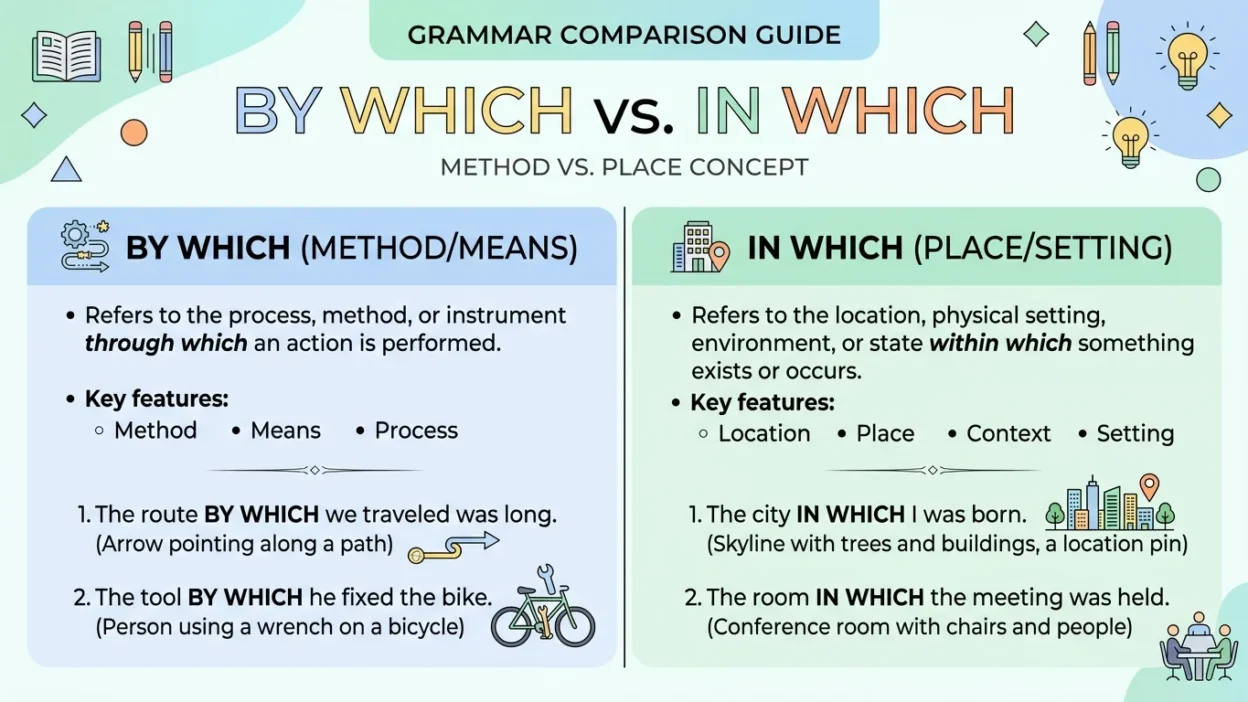
- By which → method, means, or way something happens
- In which → place, situation, or context
- Both are correct, but not interchangeable
Example:
- This is the method by which we solve the problem.
- This is the room in which we study.
What Does “By Which” Mean?
By which refers to how something happens or the method used to do something.
Think: By = how / by what means
Examples of “By Which”
- This is the process by which results are achieved.
- The system by which data is collected is efficient.
- That’s the way by which we succeed.
- The method by which he solved it was clever.
When to Use “By Which”
Use it when talking about:
- Methods
- Processes
- Tools or systems
- Cause or means
What Does “In Which” Mean?
In which refers to where something happens or the situation or context.
Think: In = inside / within
Examples of “In Which”
- This is the house in which I grew up.
- The situation in which he found himself was difficult.
- The class in which she studies is small.
- The moment in which everything changed.
When to Use “In Which”
Use it when talking about:
- Places
- Situations
- Conditions
- Time or context
By Which vs In Which: Comparison Table
| Phrase | Meaning | Usage |
|---|---|---|
| By which | Method or means | How something happens |
| In which | Place or context | Where or in what situation |
Key Difference Explained Simply
- By which = how something happens
- In which = where or in what situation it happens
Example:
- The method by which it works
- The environment in which it works
Common Mistakes People Make
Mistake 1: Using “In Which” for Methods
Incorrect: The method in which we solve this
Correct: The method by which we solve this
Mistake 2: Using “By Which” for Places
Incorrect: The house by which I live
Correct: The house in which I live
Easy Trick to Remember
Use this simple trick:
👉 By = how
👉 In = where
Or:
- By → method
- In → place or situation
Real Life Examples
Academic Writing
- The theory by which we explain this
- The system in which it operates
Everyday Use
- The way by which he learned
- The place in which they met
Professional Context
- The process by which decisions are made
- The environment in which employees work
Can You Replace Them with Simpler Forms?
Yes, especially in modern English.
- “By which” → often replaced with how
- “In which” → often replaced with where
Examples:
- The method by which → how
- The place in which → where
American vs British English
There is no difference:
- By which ✅
- In which ✅
Both are used the same way.
Frequently Asked Questions
What is the difference between by which and in which?
By which refers to method. In which refers to place or context.
Can they be used interchangeably?
No, they have different meanings.
Is by which formal?
Yes, it is commonly used in formal writing.
Is in which formal?
Yes, it is also more formal than everyday speech.
Can I replace in which with where?
Yes, in many cases.
Can I replace by which with how?
Often, yes.
Which is more common?
“In which” is slightly more common.
How do I remember the difference?
By = how, In = where
The difference between by which or in which is simple once you understand the roles they play. By which is used to describe the method or means by which something happens, while in which refers to the place, situation, or context where something occurs.
Summary:
To use them correctly, remember this easy rule: use by which when explaining how something works, and use in which when describing where or in what situation it happens.
Actionable takeaway:
Use by which for method and in which for place or context.