If you’re unsure whether to say sweeped or swept, you’re not alone. Many English learners assume verbs just add ed for past tense but that’s not always true.
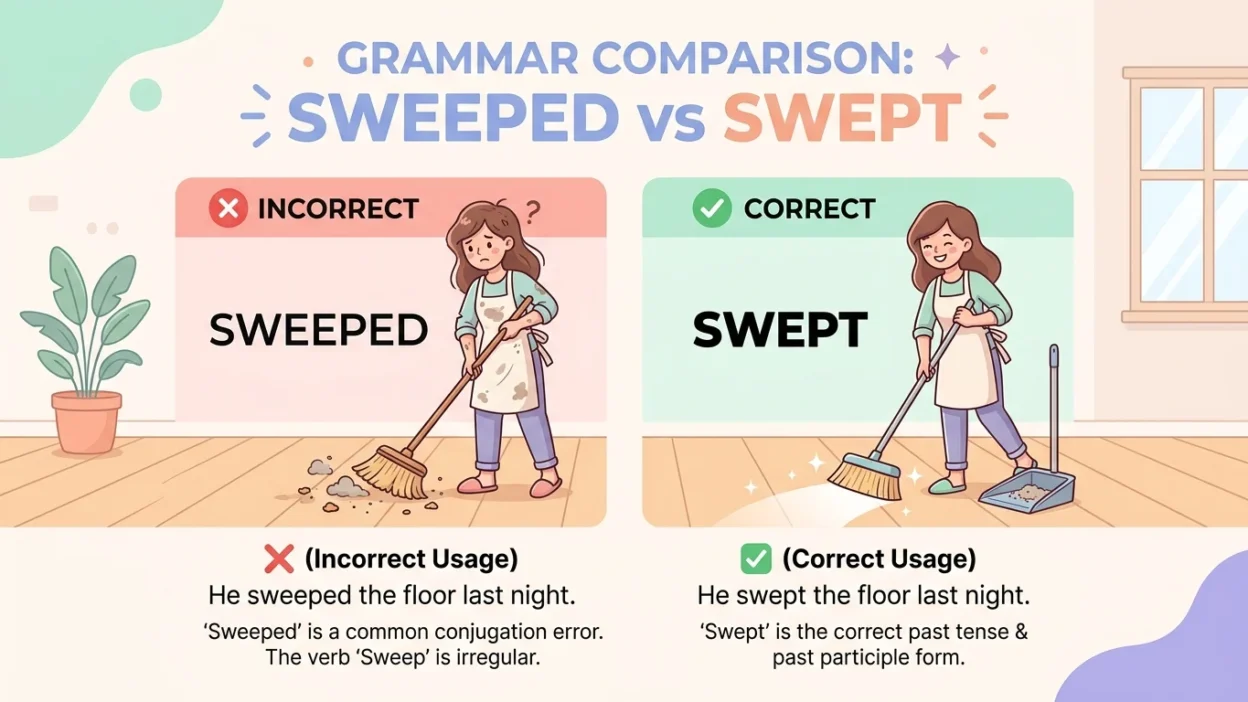
Here’s the key point: swept is correct, and sweeped is incorrect in standard English. Let’s break it down so you can use it confidently.
Quick Answer: Sweeped vs Swept
- Swept ✅ Correct
- Sweeped ❌ Incorrect
- “Sweep” is an irregular verb, so it does not follow the -ed rule
Example:
- She swept the floor.
- The wind swept through the trees.
Verb Forms of “Sweep”
To understand this clearly, look at the verb forms:
- Base form → sweep
- Past tense → swept
- Past participle → swept
So:
- Yesterday → swept
- With has/have → has swept
Why “Swept” Is Correct
“Sweep” is an irregular verb, meaning its past form changes completely instead of adding ed.
Correct:
- He swept the room.
- She has swept the floor.
Incorrect:
- He sweeped the room ❌
- She has sweeped ❌
What Does “Swept” Mean?
Swept means:
- Cleaned with a broom
- Moved quickly or forcefully
- Covered or passed over something
Examples of “Swept”
- She swept the kitchen.
- The wind swept the leaves away.
- He swept the dust off the table.
- The team swept the series (won all games).
- A feeling of joy swept over her.
Why “Sweeped” Is Incorrect
People often say sweeped because:
- Many verbs form past tense with ed
- It sounds logical
But English has many irregular verbs, and sweep is one of them.
Sweeped vs Swept: Comparison Table
| Form | Correct? | Usage | Example |
|---|---|---|---|
| Swept | ✅ Yes | Past & past participle | She swept the floor |
| Sweeped | ❌ No | Incorrect | ❌ She sweeped |
Common Mistakes People Make
Mistake 1: Adding “ed” Automatically
Incorrect: He sweeped the floor.
Correct: He swept the floor.
Mistake 2: Forgetting Past Participle
Incorrect: She has sweeped.
Correct: She has swept.
Mistake 3: Overgeneralizing Grammar Rules
Not all verbs follow regular patterns.
Easy Trick to Remember
Use this simple trick:
👉 Sweep → Swept (sounds like “kept”)
Compare:
- keep → kept
- sweep → swept
This pattern helps you remember the correct form.
Real Life Examples
Household Context
- She swept the floor.
- He has swept the room.
Nature Context
- The wind swept across the field.
- Rain swept through the city.
Figurative Use
- Emotion swept over her.
- The team swept the competition.
Similar Irregular Verbs
Here are verbs with similar patterns:
| Base | Past | Past Participle |
|---|---|---|
| keep | kept | kept |
| sleep | slept | slept |
| sweep | swept | swept |
| weep | wept | wept |
American vs British English
There is no difference:
- Swept ✅
- Sweeped ❌
Both American and British English use the same correct form.
Frequently Asked Questions
Is sweeped a real word?
No. It is incorrect in standard English.
What is the past tense of sweep?
Swept.
Can I say has sweeped?
No. Say has swept.
Why is sweep irregular?
Because English has many historical verb patterns.
Is swept used for both past and participle?
Yes.
What does swept mean?
It means cleaned or moved quickly.
How do I remember swept?
Think: keep → kept, sweep → swept
Is sweeped ever acceptable?
No, not in standard usage.
Summary: Sweeped vs Swept
The difference between sweeped vs swept is simple: swept is the correct past tense and past participle of “sweep,” while sweeped is incorrect. Even though adding “-ed” seems logical, “sweep” is an irregular verb and follows a different pattern.
To avoid mistakes, remember that swept works for both past and perfect tenses. Using the correct form will make your English sound more natural and accurate.
Actionable takeaway:
Always use swept, never sweeped.