If you’re unsure whether to use unselect or deselect, you’re not alone. Both words appear in digital interfaces and everyday language, but one is more standard and widely accepted.
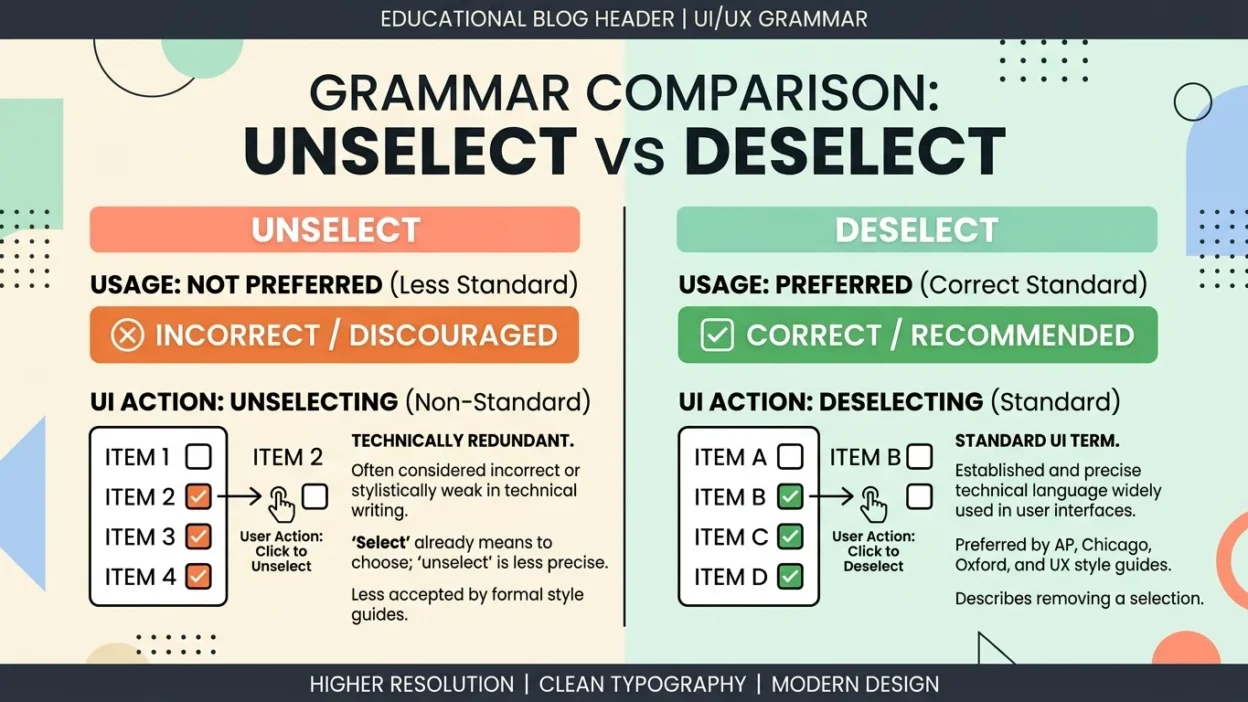
Here’s the clear answer: deselect is the preferred and correct term in most contexts, while unselect is informal and less commonly used.
Quick Answer: Unselect or Deselect
- Deselect ✅ Correct and widely accepted
- Unselect ⚠️ Informal or nonstandard
- Use deselect in professional, technical, and formal writing
Example:
- Click to deselect the option.
- Please deselect all items before continuing.
What Does “Deselect” Mean?
Deselect is a verb that means to remove a selection, especially in digital or technical contexts.
Common Uses of “Deselect”
- Deselect an option
- Deselect all items
- Deselect a checkbox
- Deselect a file
Examples of “Deselect”
- Click the button to deselect the item.
- You can deselect any option at any time.
- Please deselect the checkbox.
- The user deselected the file.
Think: de- = remove
What Does “Unselect” Mean?
Unselect also means to remove a selection, but it is:
- Less common
- Informal
- Not preferred in standard usage
Examples of “Unselect”
- You can unselect the option.
- He unselected the item.
While understandable, it’s better to avoid it in formal writing.
Unselect vs Deselect Comparison
| Word | Correct? | Usage | Preference |
|---|---|---|---|
| Deselect | ✅ Yes | Standard English | Preferred |
| Unselect | ⚠️ Less common | Informal | Avoid in formal writing |
Key Difference Explained Simply
- Deselect = standard and correct
- Unselect = understandable but not preferred
Example:
- Please deselect the option. ✅
- Please unselect the option. ⚠️
Why “Deselect” Is Preferred
The prefix de- commonly means:
- Remove
- Reverse an action
Examples:
- Activate → deactivate
- Select → deselect
This makes deselect the natural and accepted form.
Easy Trick to Remember
Use this simple trick:
👉 De = delete/remove → deselect
So:
- deselect = correct
- unselect = less standard
Common Mistakes People Make
Mistake 1: Using “Unselect” in Formal Writing
Incorrect (formal): Please unselect the option.
Correct: Please deselect the option.
Mistake 2: Assuming Both Are Equal
They are not equally accepted in professional contexts.
Mistake 3: Mixing Terms in One Document
Stick to one term—preferably deselect.
Real Life Examples
Technology Context
- Click to deselect all items.
- You can deselect the checkbox.
Everyday Use
- She deselected the wrong option.
- He forgot to deselect the file.
Informal Context
- Some apps may use “unselect,” but it’s less common.
American vs British English
There is no difference:
- Deselect ✅
- Unselect ⚠️ (less preferred everywhere)
Similar Prefix Patterns
- Do → undo
- Lock → unlock
- Select → deselect (not unselect in standard use)
Frequently Asked Questions
Which is correct unselect or deselect?
Deselect is correct and preferred.
Is unselect a real word?
It exists but is less standard.
Why is deselect better?
Because “de-” correctly indicates removing a selection.
Can I use unselect in casual writing?
Yes, but it’s better to use deselect.
Is deselect used in software?
Yes, it’s the standard term.
Are they interchangeable?
Technically yes, but deselect is preferred.
Which sounds more professional?
Deselect.
How do I remember the difference?
De = remove → deselect
Summary
The difference between unselect or deselect comes down to correctness and preference. Deselect is the standard, widely accepted term used in professional, technical, and everyday English. Unselect, while understandable, is less common and should be avoided in formal writing.
To keep your writing clear and professional, always use deselect when you mean to remove a selection.
Actionable takeaway:
Use deselect in all contexts for clear and correct English.