If you’ve ever hesitated between when I can and when can I, you’re not alone. These two phrases use the same words, but the word order changes the meaning completely.
The good news? Once you understand the difference between statements and questions, it becomes very easy to choose the right one.
Quick Answer: When I Can or When Can I
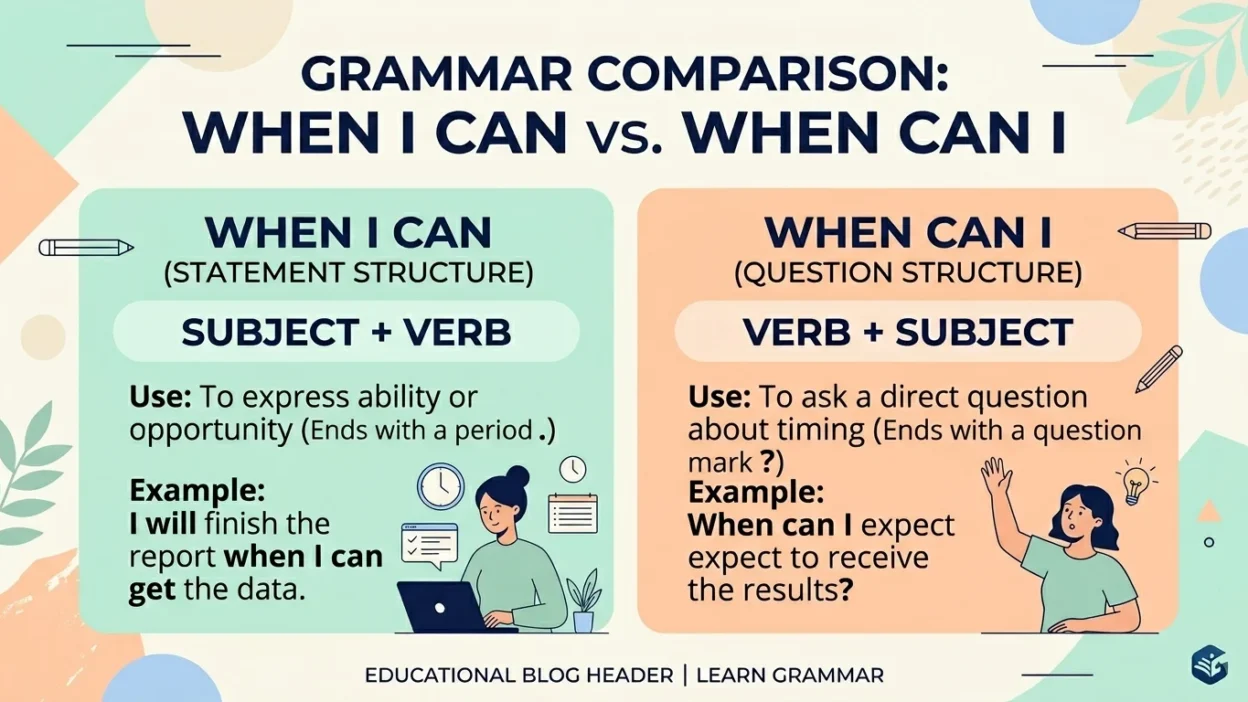
- When I can → part of a statement or dependent clause
- When can I → a direct question
- Both are correct, but used in different situations
Example:
- I’ll call you when I can.
- When can I call you?
What Does “When I Can” Mean?
When I can is used in a statement, not a question. It means at the time that I am able to do something.
Common Uses of “When I Can”
- Talking about availability
- Making plans
- Explaining timing
Examples of “When I Can”
- I’ll help you when I can.
- I’ll visit when I can.
- I respond to messages when I can.
- I’ll finish the work when I can.
Think: when I can = at a time that suits me
What Does “When Can I” Mean?
When can I is used to ask a question about permission, possibility, or timing.
Common Uses of “When Can I”
- Asking for permission
- Asking about timing
- Making plans
Examples of “When Can I”
- When can I leave?
- When can I start?
- When can I call you?
- When can I see the results?
Think: when can I = asking for timing or permission
When I Can vs When Can I Comparison
| Phrase | Type | Usage |
|---|---|---|
| When I can | Statement | Timing based on ability |
| When can I | Question | Asking for time or permission |
Key Difference Explained Simply
- When I can = statement
- When can I = question
Example:
- I’ll come when I can.
- When can I come?
Easy Trick to Remember
Use this simple rule:
👉 If it’s a question, flip the words → When can I
👉 If it’s a statement, keep normal order → When I can
Or:
- Question → can comes before I
- Statement → I comes before can
Common Mistakes People Make
Mistake 1: Using Question Form in a Statement
Incorrect: I’ll call you when can I.
Correct: I’ll call you when I can.
Mistake 2: Using Statement Form as a Question
Incorrect: When I can leave?
Correct: When can I leave?
Mistake 3: Forgetting Word Order
English questions often invert the subject and verb.
Real Life Examples
Everyday Conversation
- I’ll text you when I can.
- When can I visit you?
Work Context
- I’ll submit it when I can.
- When can I start the project?
Planning
- I’ll travel when I can.
- When can I book tickets?
American vs British English
There is no difference:
- When I can ✅
- When can I ✅
Both are used the same way.
Frequently Asked Questions
Which is correct when I can or when can I?
Both are correct depending on context.
Is when I can a complete sentence?
Usually no, it’s part of a sentence.
Is when can I a question?
Yes.
Can I use when can I in a statement?
No.
Why is word order different?
Because questions invert subject and verb.
Which is more common?
Both are common in different contexts.
How do I remember the difference?
Question = can before I.
Are they interchangeable?
No.
Summary
The difference between when I can or when can I comes down to sentence structure. When I can is used in statements to describe timing based on ability, while when can I is used to ask a question about time or permission.
To use them correctly, remember this simple rule: if you’re asking a question, use when can I. If you’re making a statement, use when I can.
Actionable takeaway:
Use when I can for statements and when can I for questions.