If you’ve ever paused before writing who to contact or whom to contact, you’re not alone. This is one of the most common grammar questions—and the good news is, it’s easier than it looks.
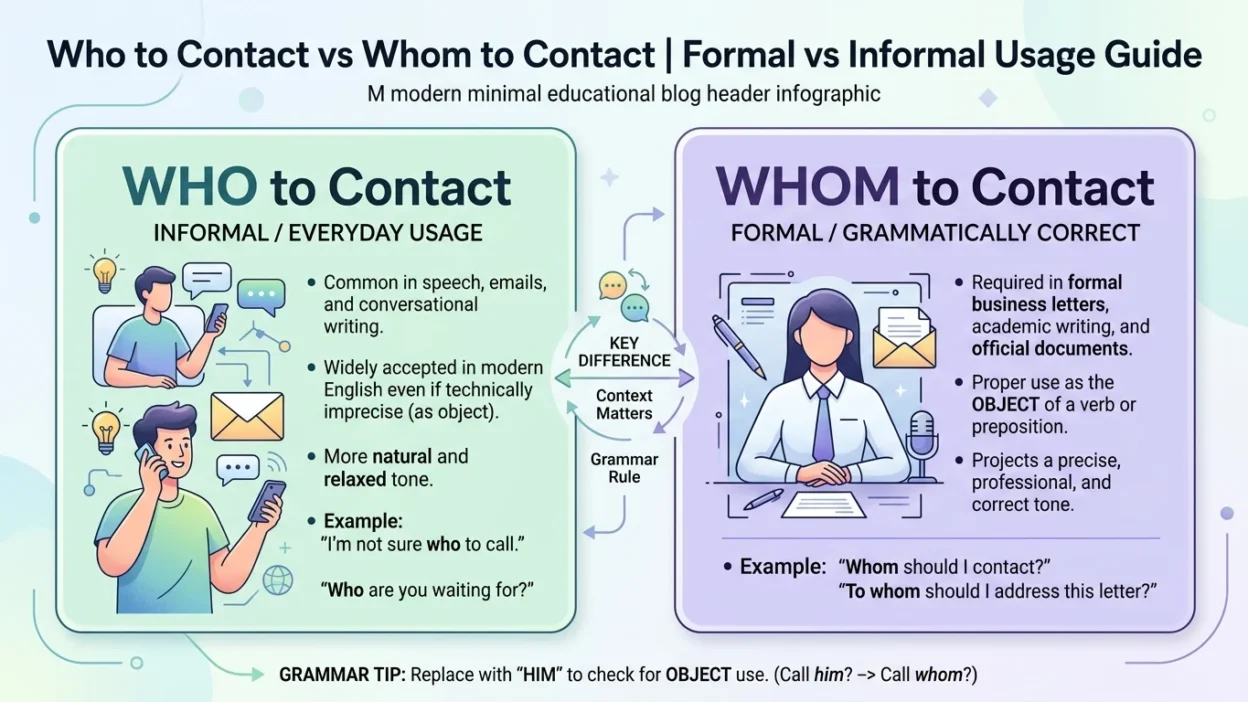
Here’s the simple truth: whom to contact is technically correct, but who to contact is more common and widely accepted in modern English.
Quick Answer: Who to Contact or Whom to Contact
- Whom to contact ✅ Grammatically correct (formal)
- Who to contact ✅ Common and acceptable (modern usage)
- Use who in everyday writing and speech
Example:
- Do you know who to contact?
- Please tell me whom to contact. (more formal)
Understanding the Rule: Who vs Whom
The difference comes down to subject vs object.
- Who = subject (does the action)
- Whom = object (receives the action)
In the phrase:
- “contact” is the verb
- The person being contacted is the object
So technically:
- whom to contact ✅
Why “Whom to Contact” Is Correct
Let’s expand the sentence:
- You should contact him → object
- Replace “him” → whom
So:
- whom to contact = correct
Example:
- I don’t know whom to contact.
Why “Who to Contact” Is Still Used
In modern English:
- who is often used instead of whom, even in object positions
- It sounds more natural in everyday conversation
Example:
- Do you know who to contact? (very common)
Who to Contact vs Whom to Contact Comparison
| Phrase | Correct? | Usage | Tone |
|---|---|---|---|
| Whom to contact | ✅ Yes | Formal grammar | Formal |
| Who to contact | ✅ Yes | Modern usage | Informal to neutral |
Key Difference Explained Simply
- Whom = grammatically precise
- Who = natural and widely used
Easy Trick to Remember
Use this simple trick:
👉 Replace with him/her → use whom
👉 Replace with he/she → use who
Example:
- Contact him → whom to contact
- He will contact → who
Common Mistakes People Make
Mistake 1: Avoiding “Whom” Completely
It’s still correct, especially in formal writing.
Mistake 2: Overusing “Whom”
Using it in casual speech can sound too formal.
Mistake 3: Not Checking the Verb
Focus on whether the word is an object.
Real-Life Examples
Everyday Use
- Do you know who to contact?
- Tell me who to contact.
Formal Writing
- Please advise whom to contact.
- The document explains whom to contact.
Workplace
- Ask HR who to contact.
- The policy states whom to contact.
American vs British English
- Both forms are used in American and British English
- Who is more common in both
- Whom appears more in formal British usage
Similar Confusions
- Who vs Whom
- Whoever vs Whomever
- Who is vs Whose
Frequently Asked Questions
Which is correct who to contact or whom to contact?
Both are correct; whom is formal, who is common.
Is whom outdated?
No, but it’s less commonly used.
Can I use who in formal writing?
Yes, though whom is more precise.
Why is whom correct here?
Because it’s the object of “contact.”
Which sounds more natural?
Who to contact.
Is this a common confusion?
Yes.
Should I always use whom?
No, only in formal contexts.
How do I remember the rule?
Him = whom, He = who
Summary
The difference between who to contact or whom to contact comes down to grammar versus modern usage. Whom to contact is technically correct because it functions as the object of the verb, while who to contact is more common and sounds natural in everyday English.
To choose the right one, think about your audience: use who for casual and general writing, and whom for formal or precise contexts.
Actionable takeaway:
Use who to contact in most situations and whom to contact when you want formal accuracy.