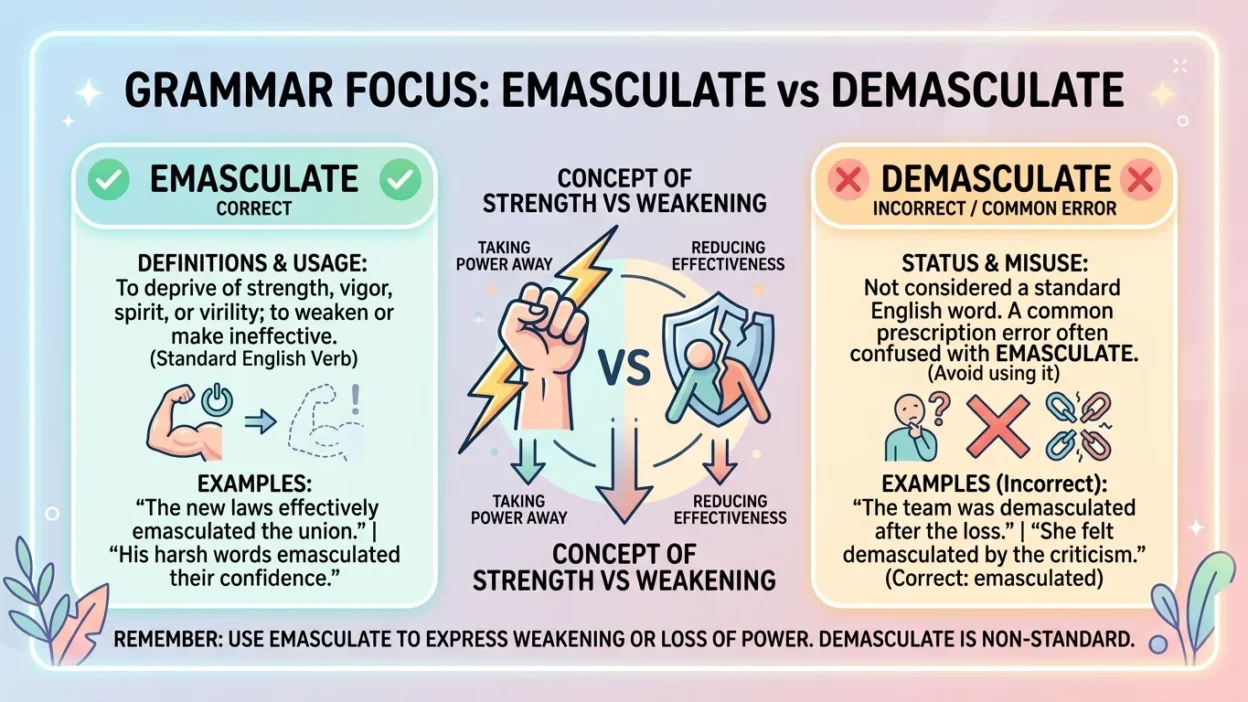
If you’re unsure whether to use emasculate or demasculate, here’s the straightforward answer: emasculate is the correct, standard English word. Demasculate is nonstandard and should be avoided in most writing.
Let’s break down the meaning, usage, and common mistakes so you can use the right word with confidence.
Quick Answer: Emasculate or Demasculate
- Emasculate ✅ Correct and standard
- Demasculate ❌ Nonstandard and rarely used
- Always use emasculate in formal and everyday English
Example:
- He felt emasculated by the criticism.
- The policy was said to emasculate leadership authority.
What Does “Emasculate” Mean?
Emasculate is a verb with two main meanings:
1. Literal Meaning
To remove or reduce male physical characteristics or reproductive ability.
2. Figurative Meaning (More Common)
To weaken, undermine, or deprive someone of strength, confidence, or authority.
Common Uses of “Emasculate”
- Emasculate authority
- Feel emasculated
- Emasculate power
- Emasculate confidence
Examples of “Emasculate”
- The changes could emasculate the organization’s authority.
- He felt emasculated after being publicly criticized.
- Critics argued the reform would emasculate the system.
- The decision emasculated their influence.
Why “Demasculate” Is Incorrect
Demasculate may appear logical because of the prefix “de-” (meaning remove), but it is not a standard English word.
Reasons to avoid it:
- Not widely accepted in dictionaries
- Sounds unnatural to native speakers
- Considered an error in formal writing
Correct:
- emasculate ✅
Incorrect:
- demasculate ❌
Emasculate vs Demasculate Comparison
| Word | Correct? | Meaning | Usage |
|---|---|---|---|
| Emasculate | ✅ Yes | Weaken or strip power | Standard English |
| Demasculate | ❌ No | None (nonstandard) | Avoid |
Easy Trick to Remember
Use this simple trick:
👉 Think: E = Effective word
👉 Demasculate = Don’t use
Or:
- Only one real word exists → emasculate
Common Mistakes People Make
Mistake 1: Adding “De-” Automatically
Incorrect: The rule will demasculate the system.
Correct: The rule will emasculate the system.
Mistake 2: Assuming Both Are Acceptable
Only emasculate is correct in standard English.
Mistake 3: Using It Without Understanding Tone
“Emasculate” can sound strong or sensitive, especially in personal contexts.
Real Life Examples
Professional Context
- The new policy may emasculate decision-making power.
Personal Context
- He felt emasculated by the situation.
Academic Writing
- Critics claim the law would emasculate institutional authority.
Tone and Sensitivity Note
The word emasculate can carry strong emotional or cultural implications, especially when referring to gender or identity. In many contexts, alternatives like:
- weaken
- undermine
- reduce
may be more neutral.
American vs British English
There is no difference:
- Emasculate ✅
- Demasculate ❌
Both varieties use emasculate only.
Frequently Asked Questions
Is demasculate a real word?
No. It is nonstandard and should be avoided.
Which is correct emasculate or demasculate?
Emasculate is correct.
What does emasculate mean?
To weaken or strip power or confidence.
Is emasculate offensive?
It can be sensitive depending on context.
Can I use demasculate informally?
It’s still considered incorrect.
What are alternatives to emasculate?
Weaken, undermine, reduce.
Why do people say demasculate?
They assume “de-” makes it correct, but it doesn’t.
Is emasculate formal?
Yes, it’s often used in formal or academic contexts.
Summary
The difference between emasculate or demasculate is simple: emasculate is the correct and standard word, while demasculate is nonstandard and should be avoided. Even though “demasculate” may seem logical, it is not accepted in proper English usage.
To write clearly and correctly, always use emasculate when you mean to weaken or reduce strength or authority. When in doubt, stick with the standard form to keep your communication professional and accurate.
Actionable takeaway:
Use emasculate only. Avoid demasculate in all contexts.