Confused about impatient and inpatient? You’re not alone. These two words look almost identical, but they have completely different meanings and uses. Mixing them up can lead to serious misunderstandings—especially in professional or medical contexts.
Let’s break it down simply so you can use each word correctly every time.
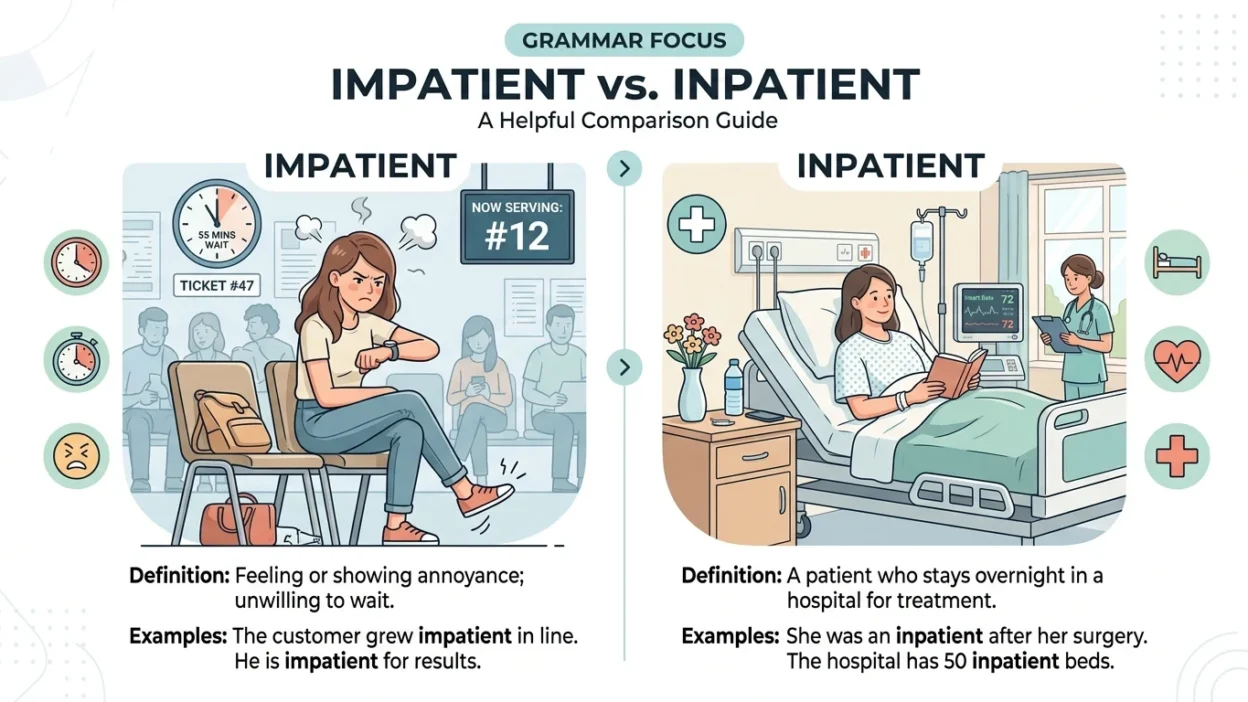
Quick Answer: Impatient vs Inpatient
- Impatient → feeling annoyed or unable to wait
- Inpatient → a person admitted to a hospital
- Same spelling pattern, very different meanings
Example:
- She became impatient while waiting.
- The doctor checked on the inpatient.
What Does “Impatient” Mean?
Impatient is an adjective that describes someone who:
- Cannot wait calmly
- Gets annoyed easily when delayed
- Feels restless or eager
Common Uses of “Impatient”
- Impatient with delays
- Feeling impatient
- Growing impatient
- Sounding impatient
Examples of “Impatient”
- He became impatient in the long line.
- She was impatient with the slow service.
- The child grew impatient waiting for food.
- I’m getting impatient now.
Think: Impatient = can’t wait
What Does “Inpatient” Mean?
Inpatient is a noun that refers to a person who stays in a hospital for treatment.
Common Uses of “Inpatient”
- Hospital inpatient
- Admitted as an inpatient
- Inpatient care
- Inpatient treatment
Examples of “Inpatient”
- The inpatient received daily care.
- He was admitted as an inpatient.
- The hospital has many inpatients.
- She is currently an inpatient.
Think: Inpatient = in the hospital
Impatient vs Inpatient Comparison
| Word | Meaning | Type | Example |
|---|---|---|---|
| Impatient | Unable to wait | Adjective | She is impatient |
| Inpatient | Hospital patient | Noun | He is an inpatient |
Key Difference Explained Simply
- Impatient = emotion or feeling
- Inpatient = person in a hospital
Example:
- The impatient patient complained.
- The inpatient received treatment.
Common Mistakes People Make
Mistake 1: Mixing Up the Words
Incorrect: The doctor treated an impatient.
Correct: The doctor treated an inpatient.
Mistake 2: Using “Inpatient” as an Emotion
Incorrect: I feel inpatient waiting here.
Correct: I feel impatient waiting here.
Mistake 3: Spelling Confusion
The difference is just one letter, but it changes everything.
Easy Trick to Remember
Use this simple trick:
👉 Impatient = I’m waiting and annoyed
👉 Inpatient = IN the hospital
Or:
- Im = emotion
- In = location
Real Life Examples
Everyday Conversation
- I got impatient waiting in traffic.
- She sounded impatient on the phone.
Medical Context
- The inpatient needs rest.
- He stayed as an inpatient for two days.
Mixed Example
- The inpatient became impatient waiting for results.
American vs British English
There is no difference:
- Impatient ✅
- Inpatient ✅
Both are used the same way.
Related Terms
- Outpatient → patient not admitted
- Patient → person receiving care
- Patience → ability to wait
Example:
- She is an outpatient now.
Frequently Asked Questions
What is the difference between impatient and inpatient?
Impatient is a feeling. Inpatient is a hospital patient.
Can inpatient be an adjective?
Yes, in phrases like “inpatient care.”
Is impatient a noun?
No, it is an adjective.
Can I say I am inpatient?
No. Say impatient.
What does inpatient mean?
A person staying in a hospital.
Why are they confusing?
Because they look very similar.
Which is more common?
Impatient is more common in daily speech.
How do I remember the difference?
In = hospital, Im = emotion
Summary: Impatient vs Inpatient
The difference between impatient vs inpatient is simple but important. Impatient describes a feeling of restlessness or frustration when waiting, while inpatient refers to a person who is admitted to a hospital for treatment. Even though they look similar, they belong to completely different contexts.
To avoid mistakes, remember this: impatient is an emotion, and inpatient is a hospital term. This small distinction will help you communicate clearly and correctly.
Actionable takeaway:
Use impatient for feelings and inpatient for hospital patients.