If you’re deciding between he is risen and he has risen, both can be correct but they’re used in different contexts. One is traditional and religious, while the other follows modern grammar rules.
Let’s make the difference clear and easy to remember.
Quick Answer: He Is Risen or He Has Risen
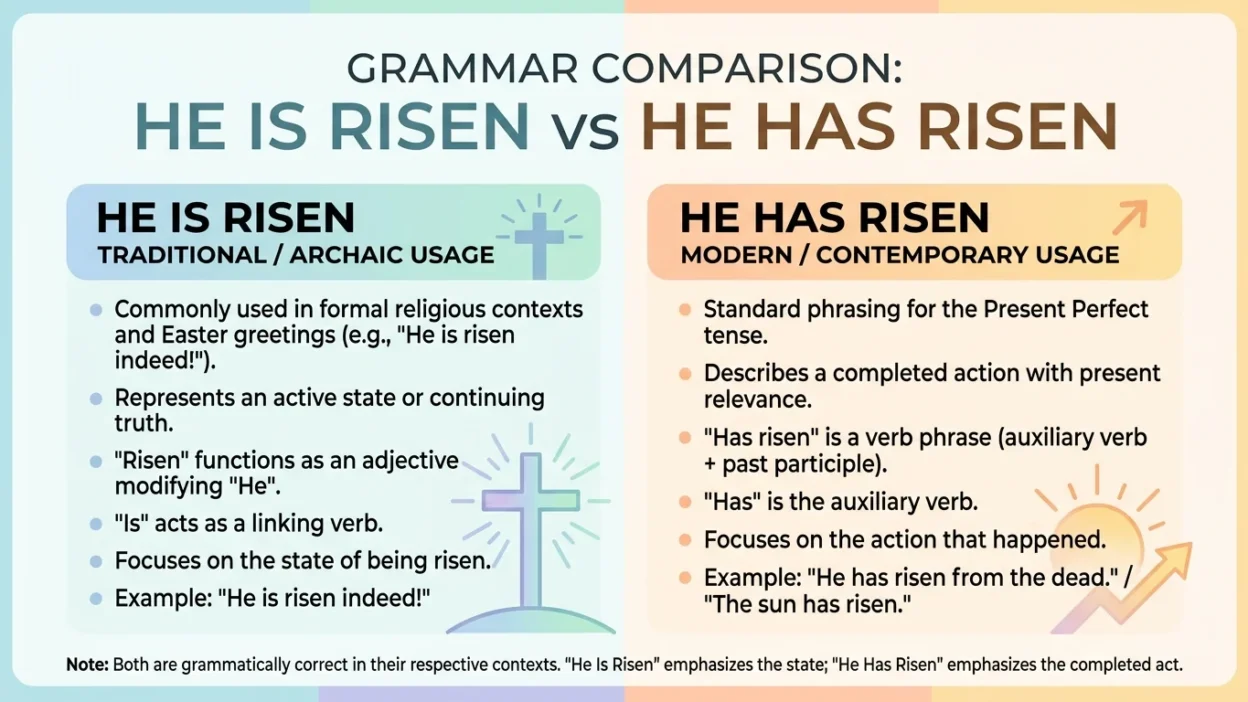
- He has risen → standard modern English (present perfect tense)
- He is risen → traditional, mainly religious or poetic usage
- Both are correct, but not interchangeable in every situation
Example:
- He has risen early today.
- He is risen (religious context).
What Does “He Has Risen” Mean?
He has risen uses the present perfect tense. It means something happened in the past and is still relevant now.
When to Use “He Has Risen”
- In everyday conversation
- In modern writing
- To describe recent actions
Examples of “He Has Risen”
- He has risen from bed.
- The sun has risen.
- He has risen to the top of his field.
- Prices have risen recently.
Think: has risen = normal grammar
What Does “He Is Risen” Mean?
He is risen is an older grammatical structure. It is mainly used in religious or poetic language.
It is most famously used in Christianity:
- “He is risen” refers to the resurrection of Jesus
When to Use “He Is Risen”
- Religious contexts
- Biblical or traditional expressions
- Poetic or literary writing
Examples of “He Is Risen”
- “He is risen!” (religious proclamation)
- The hero is risen in the tale (poetic tone)
Think: is risen = traditional/poetic
He Is Risen vs He Has Risen Comparison
| Phrase | Usage | Context |
|---|---|---|
| He has risen | Standard grammar | Everyday English |
| He is risen | Traditional/poetic | Religious or literary |
Key Difference Explained Simply
- He has risen = grammatically standard
- He is risen = traditional, not used in normal conversation
Example:
- He has risen early today. ✅
- He is risen early today. ❌ (sounds unnatural)
Why Does “He Is Risen” Exist?
In older English, some verbs used “to be” instead of “to have” as a helping verb.
So historically:
- He is risen
- He is come
Modern English changed this to:
- He has risen
- He has come
Common Mistakes People Make
Mistake 1: Using “He Is Risen” in Daily Speech
Incorrect: He is risen early today.
Correct: He has risen early today.
Mistake 2: Avoiding “He Is Risen” in Religious Context
In religious use, it is correct and meaningful.
Mistake 3: Mixing Styles
Keep tone consistent:
- Formal/modern → has risen
- Religious/traditional → is risen
Easy Trick to Remember
Use this simple rule:
👉 Daily English → has risen
👉 Religious phrase → is risen
Real Life Examples
Everyday Use
- He has risen quickly in his career.
- The temperature has risen.
Religious Context
- “He is risen” is said during Easter.
Literary Style
- The king is risen from defeat (poetic tone)
American vs British English
There is no major difference:
- He has risen ✅ (standard everywhere)
- He is risen ✅ (religious/traditional everywhere)
Frequently Asked Questions
Which is correct he is risen or he has risen?
Both are correct, depending on context.
Is he is risen grammatically correct?
Yes, but only in traditional or religious usage.
Which is more common?
He has risen is more common.
Can I use he is risen in daily conversation?
No, it sounds outdated.
Why is he is risen used in religion?
It comes from older English grammar.
Is he has risen formal?
Yes, and it’s standard.
Can both be used in writing?
Yes, depending on tone.
How do I remember the difference?
Has = modern, Is = traditional
Summary
The difference between he is risen or he has risen comes down to context and style. He has risen is the correct form in modern English and should be used in everyday conversation and writing. He is risen is an older, traditional form that is mainly used in religious or poetic contexts.
To use them correctly, remember this simple rule: choose he has risen for normal communication, and use he is risen only when the context is religious or stylistic.
Actionable takeaway:
Use he has risen in daily English and he is risen only in religious or poetic contexts.