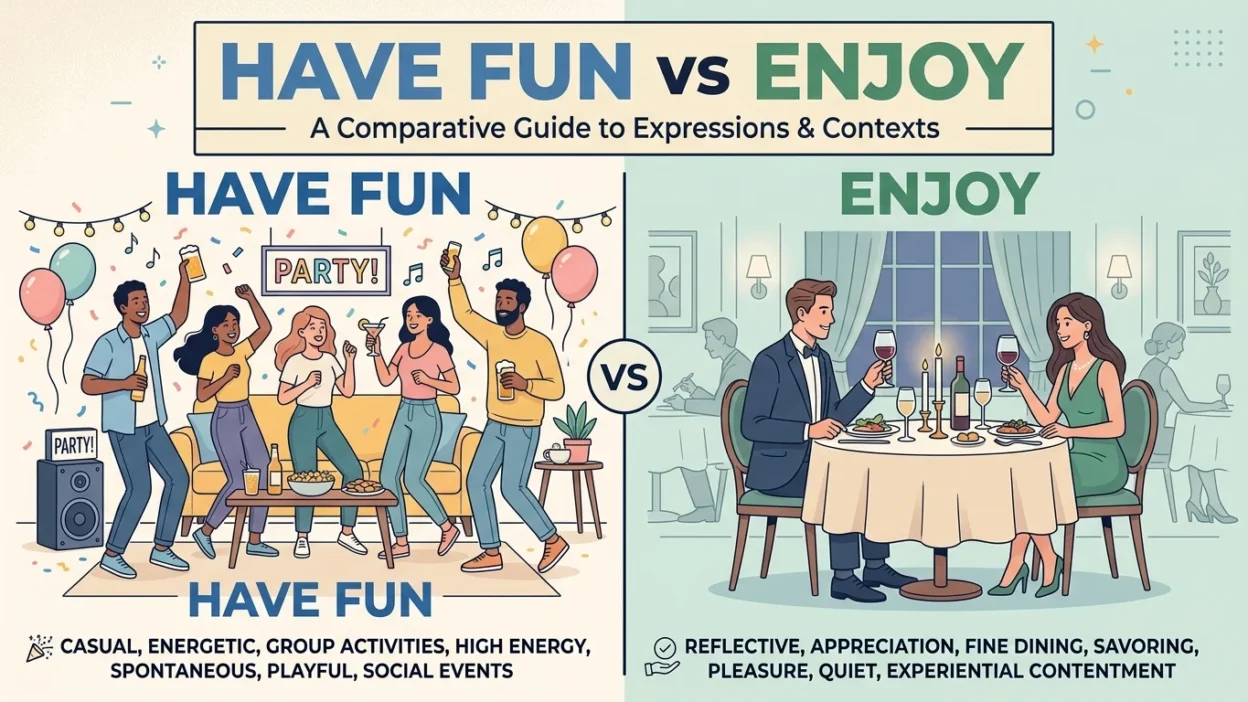
Choosing between have fun and enjoy can feel tricky because both express positive feelings. But they’re used differently depending on the sentence structure and what you want to say. One works as a complete expression, while the other usually needs an object.
In this guide, you’ll learn the clear difference between have fun vs enjoy, with meanings, examples, common mistakes, and easy tips to use them naturally.
Quick Answer: Have Fun or Enjoy
- Have fun → a complete phrase meaning “enjoy yourself”
- Enjoy → a verb that usually needs an object (something to enjoy)
- Both are correct, but used differently
Example:
- Have fun at the party!
- Enjoy the party!
What Does “Have Fun” Mean?
Have fun means to enjoy yourself or have a good time. It’s a complete expression and does not need an object.
When to Use “Have Fun”
Use it when:
- Wishing someone a good time
- Speaking casually
- Giving friendly encouragement
- Talking about enjoyment in general
Examples of “Have Fun”
- Have fun at the party!
- Have fun on your trip.
- We had fun yesterday.
- Just go and have fun!
- The kids are having fun.
This phrase is simple, friendly, and very natural.
What Does “Enjoy” Mean?
Enjoy means to take pleasure in something, but it usually needs an object (what you are enjoying).
When to Use “Enjoy”
Use it when:
- Mentioning a specific thing
- Writing slightly more formally
- Giving polite instructions or wishes
Examples of “Enjoy”
- Enjoy your meal.
- I enjoy music.
- She enjoys reading.
- Enjoy your vacation!
- They enjoyed the movie.
Notice: something always comes after enjoy.
Have Fun vs Enjoy: Side by Side Comparison
| Feature | Have Fun | Enjoy |
|---|---|---|
| Type | Phrase | Verb |
| Needs object? | ❌ No | ✅ Yes (usually) |
| Tone | Casual, friendly | Neutral to slightly formal |
| Meaning | Enjoy yourself | Take pleasure in something |
| Example | Have fun! | Enjoy your trip |
Key Difference in Meaning
The main difference is structure:
- Have fun = complete idea
- Enjoy = needs something after it
Example:
- Have fun! ✅
- Enjoy! ❌ (incomplete in formal grammar, but used casually)
Better:
- Enjoy your day!
Can You Say “Enjoy!” Alone?
In modern casual English, people do say “Enjoy!” by itself, especially in restaurants or informal situations.
Example:
- Waiter: Enjoy!
But grammatically, it’s a shortened version of:
- Enjoy your meal.
So:
- Casual: Enjoy! ✅
- Formal: Enjoy your meal. ✅
Common Mistakes People Make
Mistake 1: Using “Enjoy” Without Object (in formal writing)
Less correct: Enjoy!
Better: Enjoy your time!
Mistake 2: Overusing “Have Fun” in Formal Situations
Less formal: Have fun at the conference.
More formal: Enjoy the conference.
Mistake 3: Confusing Tone
- Have fun → casual
- Enjoy → more neutral/formal
Easy Trick to Remember
Use this simple trick:
👉 Have fun = complete sentence
👉 Enjoy = needs something after it
Or:
- Have fun → general
- Enjoy → specific
Real Life Examples
Friends
- Have fun at the party!
- Enjoy the party!
Travel
- Have fun on your trip!
- Enjoy your trip!
Food
- Have fun eating! (less common)
- Enjoy your meal! (correct)
Work/Professional
- Enjoy the event.
- Have fun (only in casual workplaces)
Tone Differences
Have Fun
- Friendly
- Casual
- Personal
Enjoy
- Neutral
- Slightly formal
- Polite
American vs British English
There is no major difference:
- Have fun ✅
- Enjoy ✅
Both are used in American and British English.
Similar Expressions
You can also say:
- Have a great time
- Enjoy yourself
- Have a good time
- Hope you enjoy it
- Take care and enjoy
Examples:
- Have a great time at the party!
- Enjoy yourself!
Frequently Asked Questions
Which is better have fun or enjoy?
Both are correct. It depends on context.
Can I say enjoy alone?
Yes, in casual speech, but better to add an object.
Is have fun informal?
Yes, it is more casual and friendly.
Is enjoy formal?
It can be neutral or slightly formal.
Can I say enjoy your day?
Yes, that is correct.
Can I say have fun your day?
No. Say: Have fun today.
Which is more polite?
Enjoy your is slightly more polite.
Are they interchangeable?
Sometimes, but not always.
Summary:
The difference between have fun vs enjoy is mainly about structure and tone. Have fun is a complete, casual expression used to wish someone a good time. Enjoy is a verb that usually needs an object, like “your meal” or “your trip,” and sounds slightly more formal.
To use them correctly, remember this: use have fun for general, friendly situations, and use enjoy when you want to mention something specific. Understanding this small difference will make your English sound more natural and appropriate in any situation.
Actionable takeaway:
Use have fun for casual wishes. Use enjoy + something for more specific or polite expressions.