If you’re unsure whether to write to bad or too bad, you’re not alone. These two look similar, but only one is correct in standard English when expressing disappointment.
The correct phrase is too bad. The phrase to bad is incorrect in this context. Let’s make it clear so you can use it confidently every time.
Quick Answer: To Bad or Too Bad
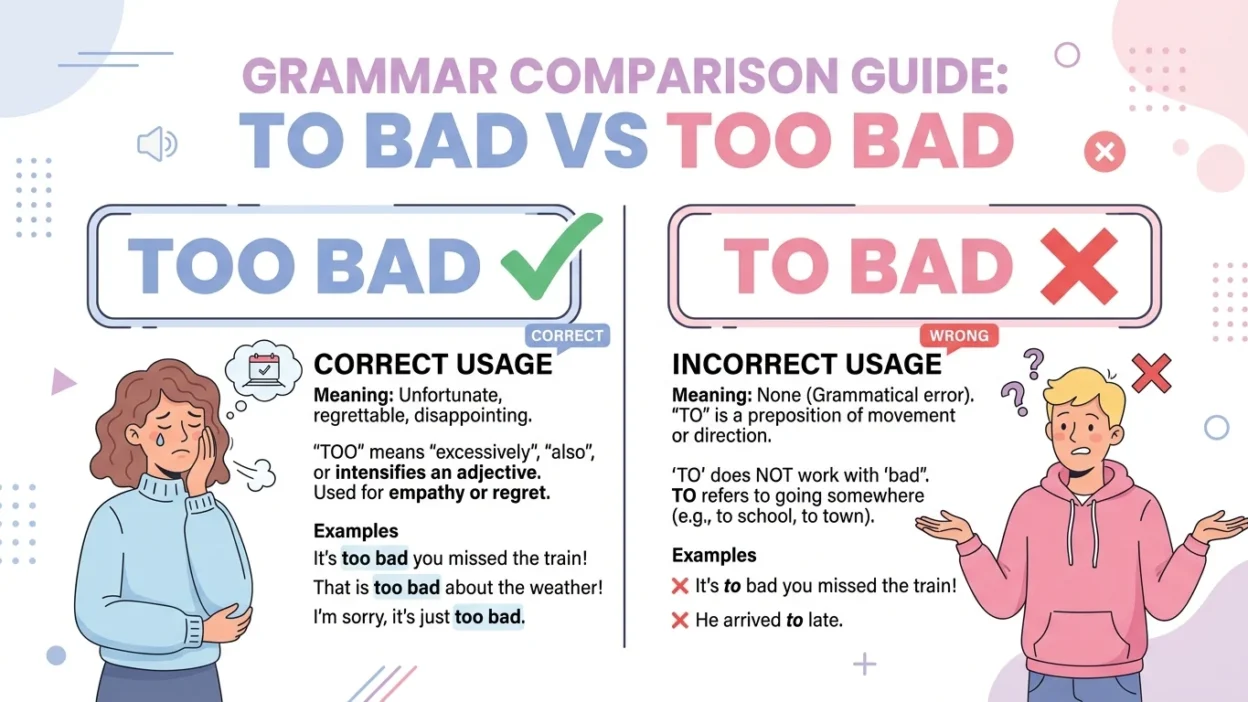
- Too bad ✅ Correct
- To bad ❌ Incorrect
- Use too when you mean very or unfortunately
Example:
- That’s too bad you missed the event.
- It’s too bad the shop is closed.
What Does “Too Bad” Mean?
Too bad is an expression used to show:
- Disappointment
- Sympathy
- Regret
- Something unfortunate
Common Uses of “Too Bad”
- Too bad you couldn’t come
- That’s too bad
- It’s too bad we missed it
Examples of “Too Bad” in Sentences
- It’s too bad you weren’t there.
- That’s too bad about the delay.
- It’s too bad the weather changed.
- Too bad we didn’t win.
- That’s really too bad.
Why “To Bad” Is Incorrect
To bad is not a correct phrase in English. The word to is a preposition or part of an infinitive verb, and it does not fit with “bad” in this expression.
Incorrect:
- That’s to bad ❌
Correct:
- That’s too bad ✅
To vs Too Explained
To understand this better:
- To → direction or part of a verb
- Go to school
- Want to eat
- Too → means very or also
- Too hot
- Me too
So:
- Too bad = very unfortunate
- To bad = ❌ no meaning
To Bad vs Too Bad Comparison
| Phrase | Correct? | Meaning | Usage |
|---|---|---|---|
| Too bad | ✅ Yes | Unfortunate | Common expression |
| To bad | ❌ No | None | Incorrect |
Always use too bad.
Easy Trick to Remember
Use this simple trick:
👉 Too = extra “o” = extra feeling
So:
- Too bad = strong feeling of regret
If you mean “very” or “unfortunately,” use too.
Common Mistakes People Make
Mistake 1: Using “To” Instead of “Too”
Incorrect: That’s to bad.
Correct: That’s too bad.
Mistake 2: Confusing “Too” with “To”
Remember:
- Too = extra meaning
- To = direction
Mistake 3: Typing Quickly
This error often happens in casual writing or texting.
Real Life Examples
Everyday Conversation
- That’s too bad you couldn’t come.
- It’s too bad the movie ended.
School Context
- It’s too bad you missed the class.
- That’s too bad about your grade.
Work Context
- It’s too bad the meeting was canceled.
- That’s too bad we lost the client.
Casual Responses
- “I can’t join.” → “That’s too bad.”
- “The event is over.” → “Too bad!”
Similar Expressions
You can also say:
- That’s unfortunate
- What a shame
- That’s disappointing
- That’s a pity
Example:
- That’s unfortunate you missed it.
American vs British English
There is no difference:
- Too bad ✅
- To bad ❌
Both American and British English use the same correct form.
Frequently Asked Questions
Is to bad correct?
No. It is incorrect.
Which is correct to bad or too bad?
Too bad is correct.
What does too bad mean?
It means something unfortunate or disappointing.
Why do we use too instead of to?
Because “too” means “very” or expresses feeling.
Can I say too bad in formal writing?
Yes, but it’s more casual. Use “unfortunate” in formal contexts.
Is too bad rude?
Not usually, but tone matters.
What is a formal alternative to too bad?
“That is unfortunate.”
How do I remember the difference?
Too = extra “o” = extra feeling
Summary:
The difference between to bad or too bad is simple: too bad is the correct phrase, and to bad is incorrect. The word too is used because it adds emphasis and expresses a feeling of disappointment or regret.
To avoid mistakes, remember that too has an extra “o,” which represents extra meaning or emotion. Whenever you want to say something is unfortunate, always choose too bad.
Actionable takeaway:
Use too bad for disappointment. Never use to bad.