If you’re unsure whether to write infront or in front, you’re not alone. This is a very common mistake because the phrase is used so often in everyday English.
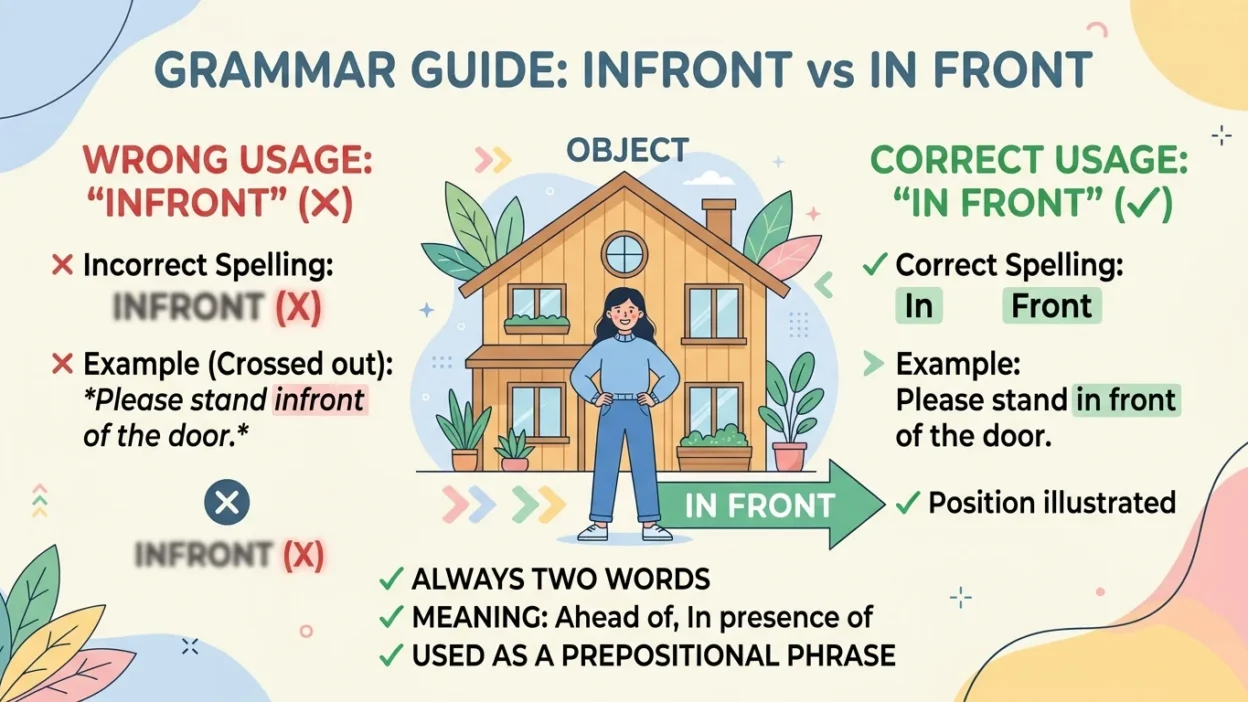
The correct form is in front (two words). The word infront (one word) is incorrect in standard English and should be avoided. Let’s break it down clearly so you can use it with confidence.
Quick Answer: Infront or In Front
- In front ✅ Correct
- Infront ❌ Incorrect
- Always write it as two separate words
Example:
- The car is in front of the house.
- She stood in front of the class.
What Does “In Front” Mean?
In front means ahead of something or someone, or facing something directly. It describes position or location.
Common Uses of “In Front”
- In front of the house
- In front of the mirror
- In front of the class
- In front of the line
- In front of the camera
Examples of “In Front” in Sentences
- He parked in front of the building.
- She stood in front of everyone.
- The dog sat in front of the door.
- They walked in front of us.
- He spoke in front of a large audience.
Why “Infront” Is Incorrect
Infront is not recognized as a standard English word. It’s simply a common spelling mistake where two separate words are incorrectly joined.
Correct:
- in front ✅
Incorrect:
- infront ❌
Infront vs In Front: Comparison Table
| Form | Correct? | Usage | Example |
|---|---|---|---|
| In front | ✅ Yes | Standard English | In front of me |
| Infront | ❌ No | Incorrect | ❌ Infront of me |
Always use in front.
Grammar Rule Explained
In front is a prepositional phrase, made up of:
- “in” (preposition)
- “front” (noun)
Because “front” is a noun, it stays separate:
- in + front = in front
This is why it is never written as one word.
Easy Trick to Remember
Use this simple trick:
👉 If you can say “in the front,” then it should be two words.
Example:
- In the front of the car → In front of the car
So:
- “in front” = always two words
Common Mistakes People Make
Mistake 1: Writing It as One Word
Incorrect: He stood infront of me.
Correct: He stood in front of me.
Mistake 2: Typing Too Fast
This error often happens in quick typing or informal writing.
Mistake 3: Confusing with Other Words
Words like “inside” or “into” are one word, which causes confusion.
Real Life Examples
Everyday Conversation
- She stood in front of me.
- The car is parked in front of the house.
School Context
- He spoke in front of the class.
- The teacher stood in front of the board.
Work Context
- She presented in front of the team.
- He waited in front of the office.
Travel Context
- The hotel is in front of the beach.
- We met in front of the station.
Similar Expressions
These phrases also follow the same pattern:
- In back (not “inback”)
- In between (not “inbetween”)
- In place (not “inplace”)
But note:
- Some words like “inside” and “into” are single words so they must be learned individually.
American vs British English
There is no difference between American and British English.
Both use:
- In front ✅
- Infront ❌
Frequently Asked Questions
Is infront one word?
No. It is incorrect.
Which is correct infront or in front?
In front is correct.
Why is in front two words?
Because it’s a prepositional phrase.
Can I ever use infront?
No. Avoid it in all writing.
Is in front formal or informal?
It works in both.
What does in front mean?
It means ahead of or before something.
Is infront accepted in informal writing?
No. It is still considered incorrect.
How do I remember the correct form?
Think: “in the front” → two words.
Summary:
The difference between infront or in front is simple: in front is the correct form, and infront is a common mistake. Since “front” is a noun, the phrase must remain two separate words.
To write correctly, always use in front when describing position or location. This small detail can make your writing clearer and more professional.
Actionable takeaway:
Always write in front as two words. Never combine it into “infront.”