If words like homophone, homograph, and homonym sound confusing, you’re not alone. They look similar, sound technical, and are often mixed up—but the differences are actually simple once you break them down.
In this guide, you’ll learn exactly what each term means, how they’re different, and how to recognize them quickly with real-life examples.
Quick Answer: Homophone vs Homograph vs Homonym
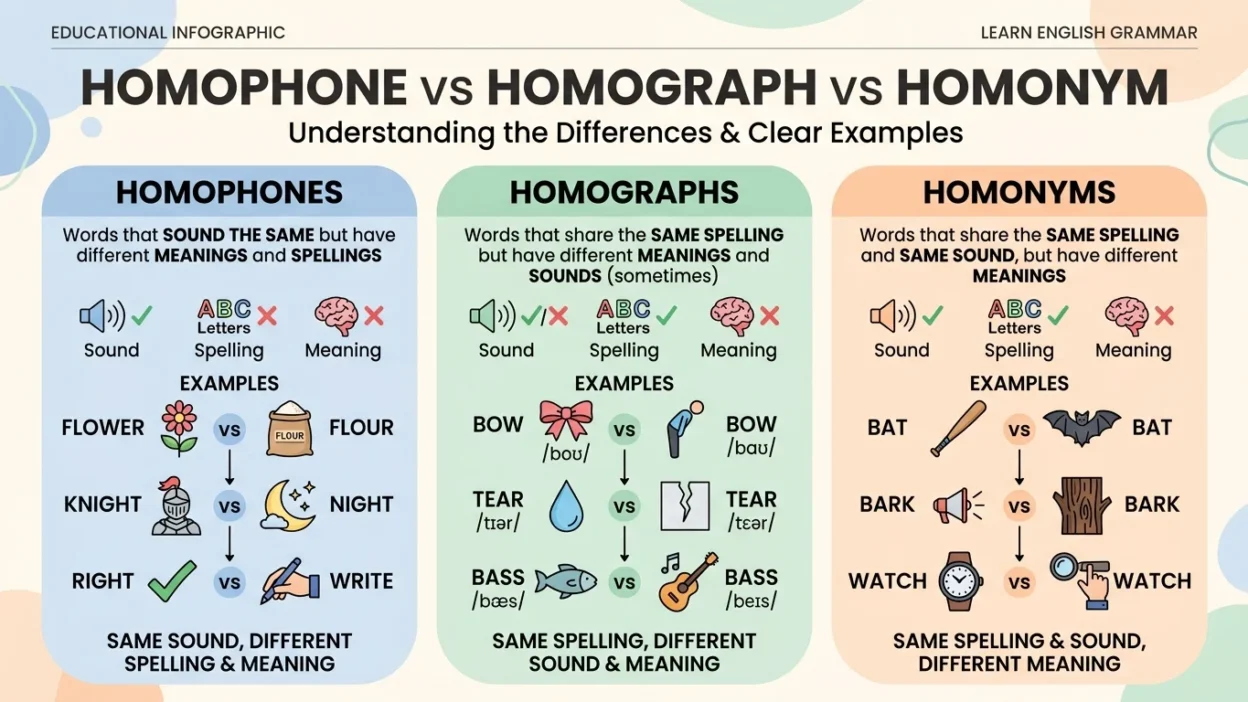
- Homophones → same sound, different meaning/spelling
- Homographs → same spelling, different meaning (sometimes different pronunciation)
- Homonyms → same spelling OR sound, different meanings (general category)
Example:
- Homophone: to / too / two
- Homograph: lead (to guide) / lead (metal)
- Homonym: bat (animal) / bat (sports tool)
What Are Homophones?
Homophones are words that sound the same but have different meanings and often different spellings.
Think: Phone = sound
Common Examples of Homophones
- to / too / two
- their / there / they’re
- see / sea
- right / write
- flour / flower
Example Sentences
- I have two apples.
- I’m going to the market.
- That’s too much!
Even though they sound identical, their meanings are different.
When to Watch Out
Homophones often cause:
- Spelling mistakes
- Grammar errors
- Confusion in writing
What Are Homographs?
Homographs are words that are spelled the same but have different meanings. Sometimes they are pronounced differently too.
Think: Graph = writing/spelling
Common Examples of Homographs
- lead (to guide) / lead (metal)
- tear (rip) / tear (drop from eye)
- wind (air) / wind (to twist)
- row (line) / row (argument)
Example Sentences
- She will lead the team.
- The pipe is made of lead.
- A tear fell from her eye.
- Don’t tear the paper.
What Are Homonyms?
Homonyms are a broader category. They include words that have the same spelling, the same pronunciation, or both—but different meanings.
So:
👉 Homonyms = Homophones + Homographs (general term)
Common Examples of Homonyms
- bat (animal) / bat (sports tool)
- bank (river edge) / bank (financial institution)
- light (not heavy) / light (illumination)
Example Sentences
- The bat flew at night.
- He hit the ball with a bat.
Homophone vs Homograph vs Homonym: Comparison Table
| Feature | Homophone | Homograph | Homonym |
|---|---|---|---|
| Same sound | ✅ Yes | Sometimes | Sometimes |
| Same spelling | ❌ Usually no | ✅ Yes | Sometimes |
| Meaning | Different | Different | Different |
| Example | to / too | lead | bat |
| Category | Specific | Specific | General |
Key Differences Explained Simply
Here’s the easiest way to remember:
- Homophones → same sound
- Homographs → same spelling
- Homonyms → same sound OR spelling
Or:
- Phone = sound
- Graph = writing
- Nym = name/group
Common Mistakes People Make
Mistake 1: Thinking They’re All the Same
They are related, but not identical.
Mistake 2: Confusing Homophones with Homographs
Example:
- “Their” and “there” → homophones, NOT homographs
Mistake 3: Not Knowing Homonym Is a Broad Term
Homonyms include both categories.
Easy Trick to Remember
Use this memory trick:
👉 Homo = same
- Phone (sound) → Homophone
- Graph (write) → Homograph
- Nym (name) → Homonym (general group)
Real Life Examples
In Writing
- Mixing up “your” and “you’re” (homophones)
In Reading
- Understanding “lead” based on context (homograph)
In Vocabulary
- Learning “bank” meanings (homonym)
Why These Matter
Understanding these helps you:
- Improve spelling
- Avoid grammar mistakes
- Write more clearly
- Understand context better
American vs British English
There is no difference in definitions:
- Homophone ✅
- Homograph ✅
- Homonym ✅
All are used the same way globally.
Frequently Asked Questions
What is the difference between homophone and homograph?
Homophones sound the same. Homographs are spelled the same.
Are homonyms the same as homophones?
Not exactly. Homophones are a type of homonym.
Can a word be both homophone and homograph?
Yes, in some cases (e.g., “bat”).
What is the easiest way to remember homophones?
Think: phone = sound
What is the easiest way to remember homographs?
Think: graph = writing
Why are homophones confusing?
Because they sound identical but have different meanings.
Are homonyms common in English?
Yes, very common.
Do these rules change in British English?
No, they stay the same.
Summary
The difference between homophone vs homograph vs homonym comes down to sound and spelling. Homophones sound the same but have different meanings and spellings. Homographs are spelled the same but may have different meanings and pronunciations. Homonyms is the broader term that includes words that share spelling or sound but have different meanings.
Once you remember the simple links—phone = sound, graph = writing, and homonym = general group—these terms become easy to understand and use correctly.
Actionable takeaway:
Use the rule: sound = homophone, spelling = homograph, both/general = homonym.