Confused about shown vs showed? You’re not alone. These two forms come from the verb show, but they’re used in different grammatical situations. Choosing the right one depends on whether you’re using a helping verb like has, have, or had.
Here’s the key idea:
- Showed = simple past
- Shown = past participle (used with helping verbs)
Let’s break it down clearly so you can use both correctly.
Quick Answer: Shown vs Showed
- Showed ✅ Simple past tense
- Shown ✅ Past participle (used with has/have/had)
- Both are correct, but used differently
Example:
- She showed me the way.
- She has shown me the way.
Verb Forms of “Show”
To understand this fully, look at the verb forms:
- Base form → show
- Past tense → showed
- Past participle → shown
So:
- Yesterday → showed
- With “has/have/had” → shown
What Does “Showed” Mean?
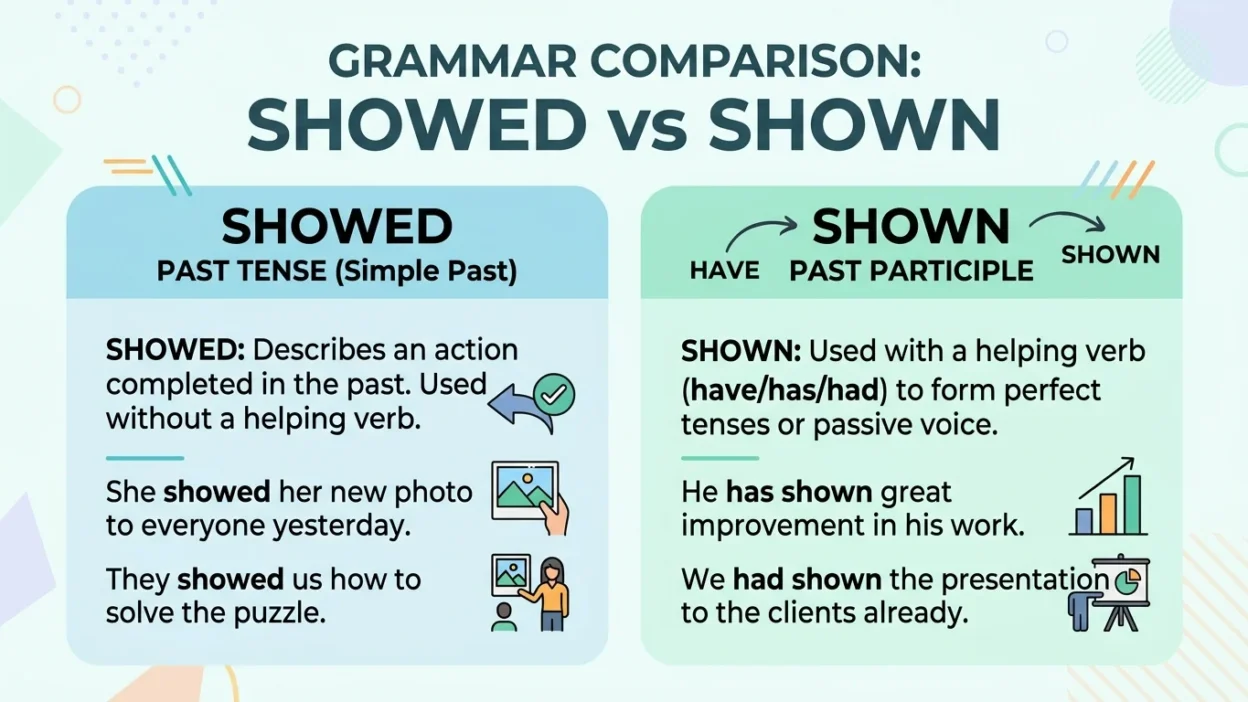
Showed is the simple past tense of “show.” It describes something that happened in the past.
Examples of “Showed”
- He showed me his work.
- She showed great courage.
- They showed us the house.
- The teacher showed a video.
- He showed his skills in the match.
Use showed when:
- Talking about a completed action in the past
- No helping verb is used
What Does “Shown” Mean?
Shown is the past participle of “show.” It is used with helping verbs like:
- has
- have
- had
- was/were (in passive voice)
Examples of “Shown”
- She has shown great improvement.
- They have shown interest.
- The results were shown on screen.
- He had shown the document earlier.
- The movie has been shown many times.
Use shown when:
- Using present perfect (has/have)
- Using past perfect (had)
- Using passive voice
Shown vs Showed: Side by Side Comparison
| Feature | Showed | Shown |
|---|---|---|
| Type | Past tense | Past participle |
| Used with has/have/had | ❌ No | ✅ Yes |
| Example | She showed me | She has shown me |
| Usage | Simple past | Perfect tenses / passive |
Key Difference in Meaning
The meaning is similar, but the grammar changes:
- Showed = past action
- Shown = completed action with connection to another time
Example:
- He showed me the file. (past event)
- He has shown me the file. (relevant now)
Common Mistakes People Make
Mistake 1: Using “Showed” with “Has/Have”
Incorrect: She has showed me.
Correct: She has shown me.
Mistake 2: Using “Shown” Without a Helping Verb
Incorrect: He shown me the way.
Correct: He showed me the way.
Mistake 3: Mixing Tenses
Make sure the verb form matches the sentence structure.
Easy Trick to Remember
Use this simple rule:
👉 No helping verb → showed
👉 Has/have/had → shown
Or:
- Showed = simple
- Shown = with “has/have/had”
Real Life Examples
Everyday Conversation
- She showed me her phone.
- She has shown me her phone.
Work Context
- He showed the report.
- He has shown the report to the team.
School Context
- The teacher showed a video.
- The teacher has shown many videos.
Passive Voice
- The results were shown on screen.
- The chart was shown in the presentation.
American vs British English
There is no difference between American and British English:
- Showed ✅
- Shown ✅
Both forms are used the same way.
Similar Verbs with Same Pattern
Many verbs follow this pattern:
| Base | Past | Past Participle |
|---|---|---|
| go | went | gone |
| write | wrote | written |
| take | took | taken |
| show | showed | shown |
Examples:
- She has written a book.
- He has taken the test.
Frequently Asked Questions
What is the difference between shown and showed?
Showed is past tense. Shown is past participle.
Can I say has showed?
No. Say has shown.
Can I say he shown me?
No. Say he showed me.
When do I use shown?
Use it with has, have, or had.
Is showed correct?
Yes, in simple past tense.
Is shown always used with has?
Usually yes, or in passive voice.
Which is more common?
Both are common, depending on context.
How do I remember the difference?
Has/have → shown
No helper → showed
Summary:
The difference between shown vs showed comes down to verb tense. Showed is the simple past tense used for actions that happened in the past. Shown is the past participle used with helping verbs like has, have, and had, or in passive sentences.
To avoid mistakes, remember this simple rule: if your sentence includes a helping verb, use shown. If not, use showed. This small grammar detail will make your English sound more natural and correct.
Actionable takeaway:
Use showed for simple past. Use shown with has/have/had.