If you’ve ever written acception when you meant exception, you’re not alone. These words look similar and sound somewhat alike, but they are not interchangeable and one of them is rarely used in everyday English.
The key point: exception is common and correct in most situations, while acception is a rare, technical word that most people never need. This guide explains acception vs exception, meanings, examples, common mistakes, and how to choose the right word every time.
Quick Answer: Acception vs Exception
- Exception ✅ Common and correct
- Acception ⚠️ Rare, technical, and rarely used
- Use exception in almost all everyday situations
- Avoid acception unless you’re writing in a technical or linguistic context
Example:
- Everyone passed the test except one exception.
- (Rare) The word has a different acception in this context.
What Does “Exception” Mean?
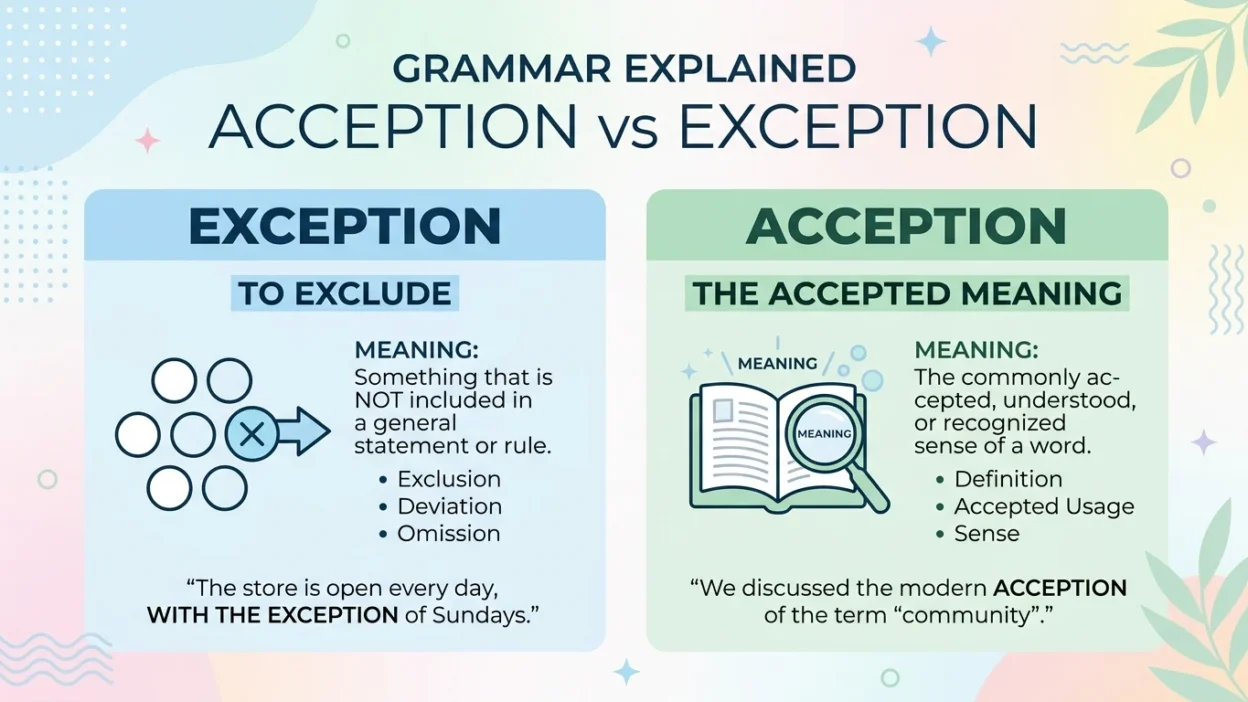
Exception means something that is excluded, different from the rule, or not included in a general statement. It’s a very common word in both spoken and written English.
Common Uses of “Exception”
- Making rules with exclusions
- Highlighting differences
- Formal writing
- Everyday conversation
- Programming and legal contexts
Examples of “Exception” in Sentences
- Everyone was invited, with one exception.
- This rule has no exceptions.
- She is an exception to the trend.
- No one passed the exam, with the exception of Ali.
- The system threw an exception error.
In all these examples, exception means something excluded or different.
When to Use “Exception”
Use exception when:
- Something does not follow the rule
- You’re excluding someone or something
- You’re describing something unusual
- Writing formal or informal English
Think: Exception = Not included / different
What Does “Acception” Mean?
Acception is a rare and technical word that means a specific meaning or interpretation of a word. It is mostly used in linguistics, philosophy, or academic writing.
Most people never use this word in daily communication.
Examples of “Acception” in Sentences
- The word has a different acception in this context.
- In this philosophical acception, the term changes meaning.
Even in these cases, people usually prefer:
- Meaning
- Interpretation
- Sense
When to Use “Acception”
Use acception only when:
- Writing academic or linguistic content
- Referring to a specific meaning of a word
- Discussing language analysis
Think: Acception = Meaning (technical use)
Acception vs Exception: Side by Side Comparison
| Feature | Exception | Acception |
|---|---|---|
| Common usage | Very common | Very rare |
| Meaning | Exclusion / not included | Meaning of a word |
| Context | Everyday English | Technical/academic |
| Recommendation | Use this | Avoid in most cases |
| Example | One exception | Different acception |
Why People Confuse Them
People mix up acception and exception because:
- They look very similar
- They sound somewhat alike
- “Acception” feels like it should relate to “accept”
- Spellcheck sometimes doesn’t catch it
But their meanings are completely different.
Common Mistakes People Make
Mistake 1: Using “Acception” Instead of “Exception”
Incorrect: There is one acception to this rule.
Correct: There is one exception to this rule.
Mistake 2: Assuming “Acception” Means “Acceptance”
Incorrect: Her acception of the offer was quick.
Correct: Her acceptance of the offer was quick.
Mistake 3: Overusing Rare Words
Using acception instead of simple words like “meaning” can confuse readers.
Easy Trick to Remember the Difference
Use this simple memory trick:
- Exception = EX = EXclude (not included)
- Acception = Accept → meaning (rare use)
Or even easier:
- If you mean rule breaking, use exception
- If you mean word meaning (rare), use acception
Real Life Examples
Everyday Conversation
- Everyone came, with one exception.
- This rule has no exceptions.
Academic Context
- The word has a new acception in modern usage.
Workplace
- There are no exceptions to this policy.
- She is an exceptional employee.
American vs British English
There is no difference between American and British English:
- Exception ✅
- Acception (rare in both)
Both follow the same usage rules.
Related Words to Know
- Accept → receive
- Acceptance → agreement
- Exception → exclusion
- Exceptional → outstanding
Example:
- He accepted the offer.
- She is an exception.
Frequently Asked Questions
Is acception a real word?
Yes, but it is rare and mostly used in technical contexts.
Which is correct acception or exception?
Exception is correct in almost all cases.
What does acception mean?
It means a specific meaning or interpretation of a word.
Why is acception rarely used?
Because simpler words like “meaning” are preferred.
Is exception common in English?
Yes. It is widely used in everyday language.
Can I use acception instead of exception?
No. They have different meanings.
What is a simple replacement for acception?
Use “meaning” or “interpretation.”
How do I remember exception?
Think: EX = exclude
Summary:
The difference between acception vs exception is clear once you understand their meanings. Exception is a common word used to describe something that is excluded from a rule or different from the norm. It’s used in everyday English, formal writing, and many professional contexts. Acception, on the other hand, is a rare, technical term that refers to a specific meaning of a word and is mostly used in academic fields.
In most situations, you should use exception. If you’re ever unsure, avoid acception and choose a simpler word like “meaning” instead. This ensures your writing stays clear, natural, and easy to understand.
Actionable takeaway:
Use exception for rules and exclusions. Avoid acception unless writing technical or linguistic content.