Confused about too vs to? You’re definitely not alone. These two tiny words look almost the same, sound identical, and are among the most commonly mixed up words in English. But they serve completely different purposes in a sentence.
This simple guide will help you master too vs to with clear meanings, examples, common mistakes, and an easy trick to remember the difference every time.
Quick Answer: Too vs To
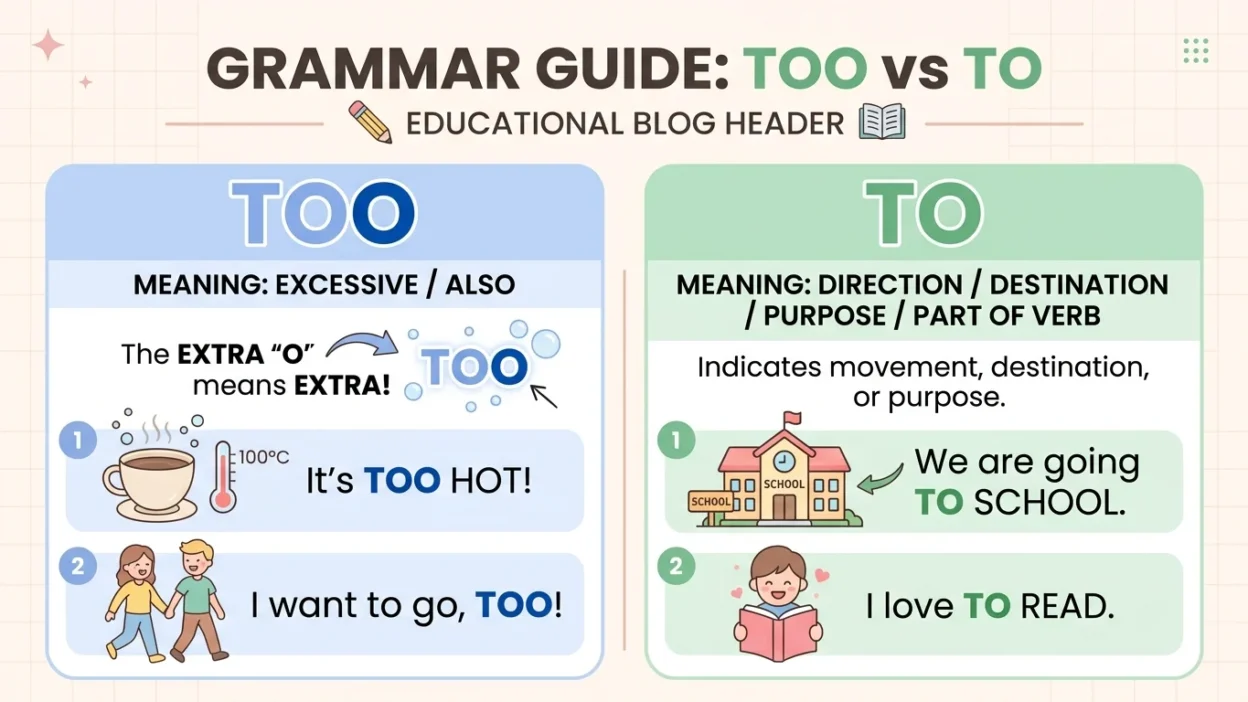
- To → a preposition or part of an infinitive verb
- Too → means also or excessively
- To shows direction, purpose, or connection
- Too adds meaning like “extra” or “as well”
Example:
- I’m going to the store.
- I want to eat.
- I’m coming too.
- It’s too hot today.
What Does “To” Mean?
To is one of the most commonly used words in English. It has two main uses:
1. As a Preposition
It shows direction, place, or relationship.
Examples:
- She walked to the park.
- Give this to him.
- I’m going to school.
- The answer belongs to me.
2. As Part of an Infinitive Verb
It comes before the base form of a verb.
Examples:
- I want to learn.
- She likes to read.
- We plan to travel.
- They need to finish the work.
Think: To = direction or action
What Does “Too” Mean?
Too has two main meanings:
1. Meaning “Also”
It means in addition or as well.
Examples:
- I want to come too.
- She is coming too.
- Can I join too?
- He likes pizza too.
2. Meaning “Excessively”
It means more than enough or more than needed.
Examples:
- It’s too hot outside.
- This bag is too heavy.
- You’re talking too fast.
- The test was too difficult.
Think: Too = extra or also
Too vs To: Side by Side Comparison
| Feature | To | Too |
|---|---|---|
| Type | Preposition / infinitive marker | Adverb |
| Meaning | Direction, purpose | Also / excessive |
| Usage | To go, to eat, to school | Too hot, me too |
| Example | Go to bed | It’s too late |
| Memory trick | Short word | Extra “o” = extra meaning |
Easy Trick to Remember the Difference
Use this simple trick:
- Too has an extra “o” → means extra
- Too hot (extra hot)
- Me too (extra person)
- To is shorter → used for basic connection
- Go to school
- Want to eat
This trick works almost every time.
Common Mistakes People Make
Mistake 1: Using “To” Instead of “Too”
Incorrect: I want to come to.
Correct: I want to come too.
Mistake 2: Using “Too” Instead of “To”
Incorrect: I’m going too the store.
Correct: I’m going to the store.
Mistake 3: Confusing Infinitives
Incorrect: I want too eat.
Correct: I want to eat.
Real Life Examples
Everyday Conversation
- I’m going to the market.
- I’ll come too.
School Context
- She needs to study.
- This homework is too hard.
Work Context
- Send this to the manager.
- I’m busy too.
Travel Context
- We’re going to Dubai.
- The weather is too hot.
When Both Appear in One Sentence
Sometimes both words appear together:
- I’m going to the party too.
- She wants to come too.
- He is going to eat too much.
This is completely correct.
Similar Confusing Words
These are often confused along with too vs to:
- Two (number)
- Your vs You’re
- There vs Their vs They’re
Example:
- I have two books.
- I’m going to school too.
American vs British English
There is no difference between American and British English.
Both use:
- To ✅
- Too ✅
The meanings and grammar rules are the same.
Frequently Asked Questions
What is the difference between too and to?
To shows direction or action. Too means also or excessively.
When should I use too?
Use too when you mean “also” or “more than enough.”
When should I use to?
Use to for direction or before verbs.
Is it me too or me to?
Correct: Me too.
Is it too much or to much?
Correct: Too much.
Can a sentence have both to and too?
Yes. Example: I want to come too.
Why is too spelled with two o’s?
To show “extra,” matching its meaning.
Which is more common?
To is used more frequently.
Summary:
The difference between too vs to is simple but important. To is used for direction, connection, and before verbs, while too means also or more than enough. Even though they sound the same, their meanings are completely different, and using the wrong one can confuse your sentence.
To avoid mistakes, remember this: too has an extra “o,” which means extra meaning. Whenever you mean “also” or “excessively,” choose too. For everything else like movement, purpose, or verbs use to. With a little practice, this common confusion becomes easy to fix.
Actionable takeaway:
If you mean “also” or “extra,” use too. Otherwise, use to.