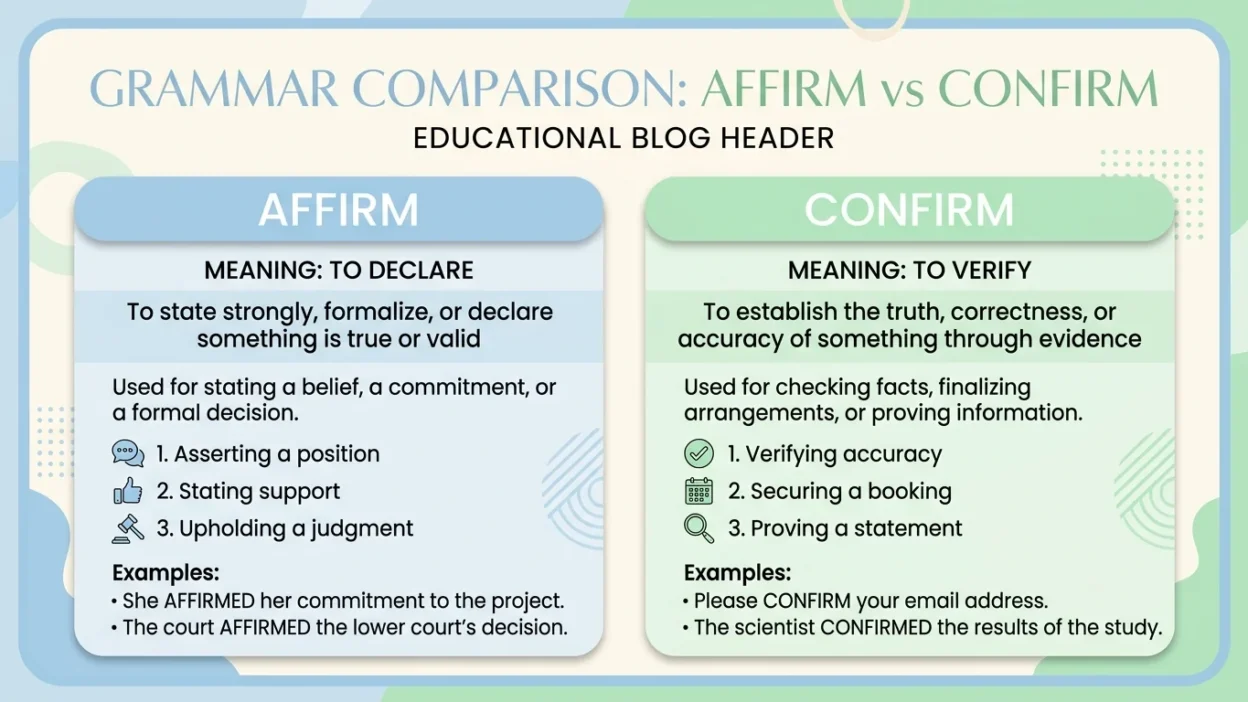
The words affirm and confirm often feel similar they both relate to saying something is true. But they’re not interchangeable. One focuses on declaring or asserting, while the other is about verifying or checking accuracy.
If you’ve ever paused wondering which one to use, this guide will make it simple. Let’s break down affirm vs confirm with meanings, examples, common mistakes, and easy tips.
Quick Answer: Affirm vs Confirm
- Affirm → to state or declare something as true
- Confirm → to verify or prove something is true
- Affirm = say it’s true
- Confirm = check it’s true
Example:
- She affirmed her belief.
- He confirmed the appointment.
What Does “Affirm” Mean?
Affirm means to declare, state, or assert something positively. It’s often used in formal, legal, or emotional contexts where someone expresses belief, support, or agreement.
Common Uses of “Affirm”
- Affirm a belief
- Affirm a decision
- Affirm a judgment (legal)
- Affirm support
- Affirm identity
Examples of “Affirm” in Sentences
- She affirmed her commitment to the project.
- The court affirmed the decision.
- He affirmed his loyalty.
- The teacher affirmed the student’s efforts.
- They affirmed their values publicly.
In these examples, affirm means to state or express strongly.
When to Use “Affirm”
Use affirm when:
- Declaring something confidently
- Expressing belief or support
- Making formal statements
- Reinforcing ideas or identity
Think: Affirm = Declare
What Does “Confirm” Mean?
Confirm means to verify, check, or make sure something is true or correct. It’s used in everyday communication, business, and formal contexts.
Common Uses of “Confirm”
- Confirm an appointment
- Confirm details
- Confirm a booking
- Confirm information
- Confirm attendance
Examples of “Confirm” in Sentences
- Please confirm your attendance.
- She confirmed the meeting time.
- The email confirmed the reservation.
- He confirmed the report’s accuracy.
- Can you confirm this information?
Here, confirm means to verify or check.
When to Use “Confirm”
Use confirm when:
- Checking facts
- Verifying information
- Finalizing plans
- Ensuring accuracy
Think: Confirm = Verify
Affirm vs Confirm: Side by Side Comparison
| Feature | Affirm | Confirm |
|---|---|---|
| Meaning | Declare something true | Verify something is true |
| Focus | Expression | Validation |
| Usage | Formal, emotional, legal | Everyday, business |
| Example | Affirm belief | Confirm booking |
| Memory trick | Affirm = say | Confirm = check |
Key Difference in Meaning
The core difference is:
- Affirm = you are stating something is true
- Confirm = you are checking or proving something is true
Example:
- She affirmed her opinion. (she stated it)
- She confirmed the details. (she checked them)
Common Mistakes People Make
Mistake 1: Using “Affirm” Instead of “Confirm”
Incorrect: Please affirm your attendance.
Correct: Please confirm your attendance.
Why? You’re verifying, not declaring.
Mistake 2: Using “Confirm” Instead of “Affirm”
Incorrect: He confirmed his beliefs.
Better: He affirmed his beliefs.
Mistake 3: Treating Them as Synonyms
They are related but not interchangeable in most cases.
Easy Trick to Remember the Difference
Use this simple trick:
- Affirm = A = Announce
- Confirm = C = Check
Or:
- Affirm → say it
- Confirm → prove it
Real Life Examples
Workplace
- She confirmed the meeting time.
- He affirmed his support for the plan.
Legal Context
- The court affirmed the ruling.
- The evidence confirmed the claim.
Personal Life
- I can confirm your booking.
- She affirmed her confidence.
Emails
- Please confirm receipt of this email.
- We affirm our commitment to quality.
Tone Difference
Affirm
- Formal
- Strong
- Emotional or declarative
Confirm
- Practical
- Neutral
- Common in daily use
Synonyms
Affirm Synonyms
- Declare
- Assert
- State
- Support
- Validate (in emotional sense)
Confirm Synonyms
- Verify
- Check
- Validate (technical sense)
- Approve
- Establish
American vs British English
There is no difference between American and British English. Both use:
- Affirm ✅
- Confirm ✅
The meanings and usage are the same.
Frequently Asked Questions
What is the difference between affirm and confirm?
Affirm means to declare something true. Confirm means to verify it.
Can affirm and confirm be used interchangeably?
Sometimes, but usually they have different meanings.
Which is more common?
Confirm is more common in everyday use.
Is affirm formal?
Yes. It is more formal and less commonly used.
Is confirm used in emails?
Yes. Very commonly.
Can I say confirm your attendance?
Yes. That is correct.
What does affirm mean in law?
It means to uphold or agree with a decision.
How do I remember the difference?
Affirm = Announce
Confirm = Check
Summary:
The difference between affirm vs confirm comes down to declaring vs verifying. Affirm means to state or declare something as true, often in formal or emotional contexts. Confirm means to check, verify, or ensure something is true, and it’s used much more often in everyday communication.
To use them correctly, remember that affirm expresses belief, while confirm checks facts. Choosing the right word makes your writing clearer and more precise.
Actionable takeaway:
Use affirm when declaring something. Use confirm when verifying something.