
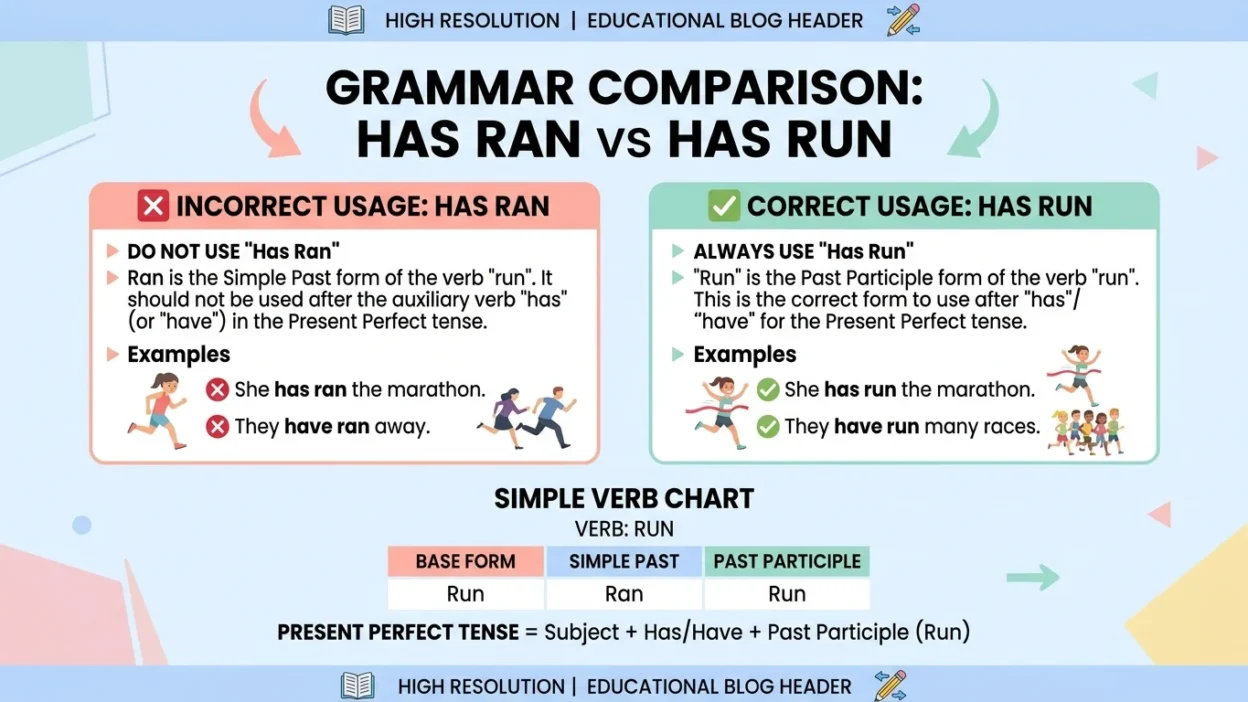
If you’re unsure whether to write has ran or has run, you’re not alone. This is a very common grammar mistake because both ran and run are forms of the verb “run.” But only one works with has/have/had.
The correct form is has run. The phrase has ran is grammatically incorrect in standard English. Let’s break down why so it becomes easy to remember.
Quick Answer: Has Ran or Has Run
- Has run ✅ Correct
- Has ran ❌ Incorrect
- Use has + past participle (run)
- “Ran” is simple past, not used with “has”
Example:
- He has run five miles today.
- She has run this race before.
Understanding the Verb Forms of “Run”
To understand this clearly, you need to know the three main forms of the verb:
- Base form → run
- Past simple → ran
- Past participle → run
So:
- Yesterday → He ran
- With “has” → He has run
Why “Has Run” Is Correct
When you use has, have, or had, you must use the past participle form of the verb.
Structure:
- has/have/had + past participle
Correct:
- She has run a marathon.
- They have run this program before.
- He had run out of time.
Incorrect:
- She has ran ❌
- They have ran ❌
What Does “Has Run” Mean?
Has run is used in the present perfect tense, which connects the past to the present.
It can mean:
- Something happened recently
- Something happened at an unspecified time
- Something is still relevant now
Examples of “Has Run”
- He has run five kilometers today.
- She has run this business for years.
- The machine has run smoothly all day.
- He has run out of patience.
- She has run in many competitions.
When to Use “Ran”
Use ran only in simple past tense, without “has/have/had.”
Examples of “Ran”
- He ran yesterday.
- She ran to the store.
- They ran a successful campaign.
- The dog ran across the field.
Has Ran vs Has Run: Comparison Table
| Phrase | Correct? | Usage | Example |
|---|---|---|---|
| Has run | ✅ Yes | Present perfect | He has run today |
| Has ran | ❌ No | Incorrect grammar | ❌ He has ran |
Common Mistakes People Make
Mistake 1: Mixing Past and Past Participle
Incorrect: He has ran fast.
Correct: He has run fast.
Mistake 2: Forgetting Verb Forms
People remember:
run → ran
but forget:
run → run (past participle)
Mistake 3: Overgeneralizing Rules
Not all verbs follow the same pattern. “Run” is irregular.
Easy Trick to Remember
Use this simple rule:
👉 If you see has/have/had, use run, NOT ran
Or remember:
- Ran = alone (past)
- Run = with has/have/had
Real Life Examples
Everyday Conversation
- I have run out of time.
- He has run away.
Sports Context
- She has run many races.
- He ran yesterday.
Work Context
- She has run the company for years.
- He ran the meeting last week.
Technology Context
- The system has run without errors.
- The program ran successfully.
Similar Verbs That Follow This Pattern
Many irregular verbs work like this:
| Base | Past | Past Participle |
|---|---|---|
| go | went | gone |
| eat | ate | eaten |
| see | saw | seen |
| run | ran | run |
Examples:
- She has gone home
- He has eaten lunch
- They have seen it
American vs British English
There is no difference between American and British English.
Both use:
- Has run ✅
- Has ran ❌
Frequently Asked Questions
Is has ran correct?
No. It is incorrect.
Why is has run correct?
Because “run” is the past participle used with “has.”
What tense is has run?
Present perfect tense.
Can I say have ran?
No. Say have run.
When do we use ran?
Use ran in simple past tense without “has/have.”
Is run always correct with has?
Yes, when used as past participle.
Why is run used twice (present and past participle)?
Because it’s an irregular verb.
How do I remember this?
Has/have → use run, not ran
Summary:
The difference between has ran or has run is based on verb tense. Has run is correct because it uses the past participle form required in the present perfect tense. Has ran is incorrect because “ran” is only used in simple past tense, not with helping verbs like “has.”
To avoid mistakes, remember this simple rule: whenever you use has, have, or had, always use run, not ran. This small grammar fix will make your English sound more accurate and natural.
Actionable takeaway:
If you see has/have/had, always use run never ran.