Confused about paid vs payed? You’re not alone. These two words look similar, but they are not interchangeableband one of them is rarely used in everyday English.
Here’s the key takeaway: paid is almost always the correct word you need, while payed is a very specific, technical term used mainly in nautical contexts. This guide explains the difference clearly so you can use the right one every time.
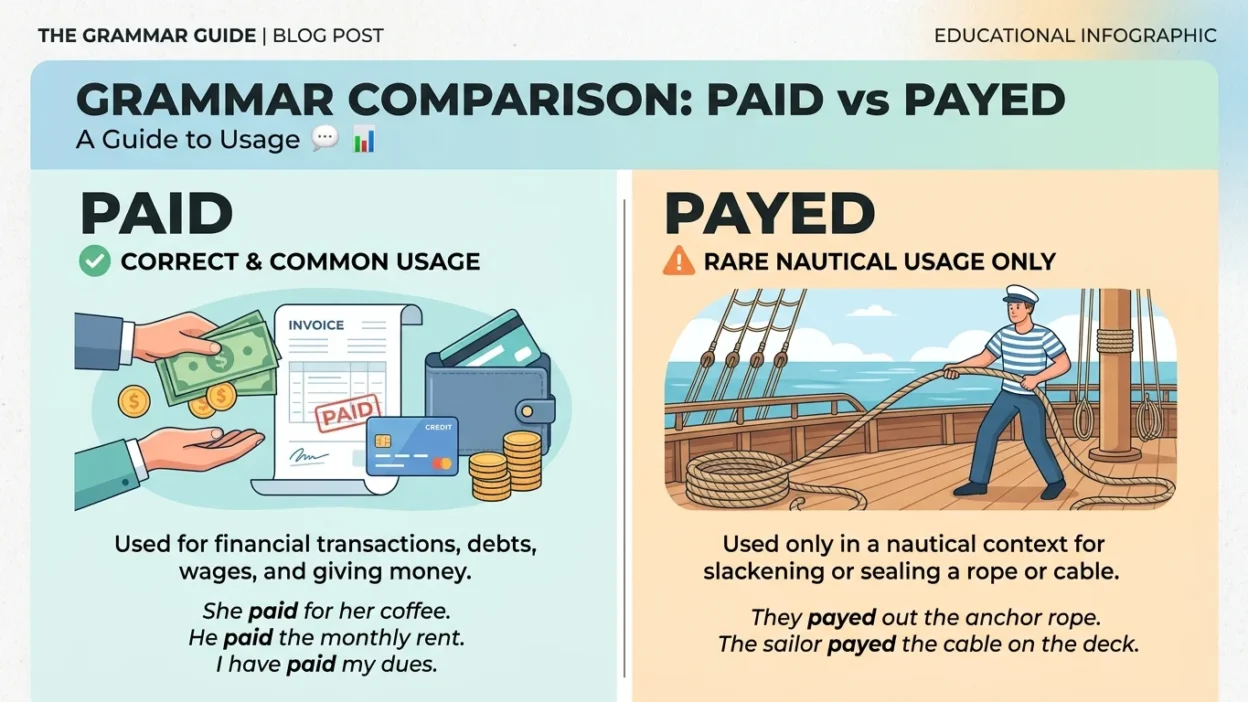
Quick Answer: Paid vs Payed
- Paid ✅ Correct in almost all cases
- Payed ⚠️ Rare, used in nautical contexts only
- Use paid for money, work, and general situations
Example:
- I paid the bill.
- The sailor payed out the rope. (rare use)
What Does “Paid” Mean?
Paid is the past tense and past participle of the verb pay, meaning to give money, settle a bill, or compensate someone.
It’s the form you’ll use in everyday English.
Common Uses of “Paid”
- Paid a bill
- Paid a salary
- Paid attention
- Paid a fine
- Paid for something
Examples of “Paid” in Sentences
- She paid the rent on time.
- I paid for the meal.
- He paid attention in class.
- They paid the workers fairly.
- The company has paid its debts.
In all these cases, paid is correct.
When to Use “Paid”
Use paid when:
- Talking about money
- Referring to compensation
- Describing completed payment
- Using common expressions
Think: Paid = money or action completed
What Does “Payed” Mean?
Payed is a rare and specialized form of “pay.” It is mainly used in nautical (sailing) contexts.
It means:
- To let out rope or cable gradually
- To seal or waterproof a ship with tar (pitch)
Examples of “Payed” in Sentences
- The crew payed out the rope slowly.
- The sailors payed the deck with tar.
These uses are uncommon in everyday writing.
When to Use “Payed”
Use payed only when:
- Writing about ships or sailing
- Referring to rope, cables, or sealing decks
- Using technical maritime language
Think: Payed = ships and ropes
Paid vs Payed: Side by Side Comparison
| Feature | Paid | Payed |
|---|---|---|
| Correct for general use | ✅ Yes | ❌ No |
| Meaning | Gave money / completed payment | Let out rope / sealed ship |
| Usage frequency | Very common | Very rare |
| Context | Everyday English | Nautical/technical |
| Example | Paid the bill | Payed out rope |
Why People Confuse Paid and Payed
This confusion happens because:
- Most verbs form past tense with -ed
- People assume “pay” → “payed”
- English irregular verbs don’t follow regular patterns
But “pay” is irregular:
- pay → paid (not payed)
Common Mistakes People Make
Mistake 1: Using “Payed” for Money
Incorrect: I payed the bill.
Correct: I paid the bill.
Mistake 2: Assuming Regular Verb Pattern
Incorrect: She payed her fees.
Correct: She paid her fees.
Mistake 3: Not Knowing “Payed” Exists
Some people think payed is just wrong but it’s actually correct in rare contexts.
Easy Trick to Remember the Difference
Use this simple trick:
👉 If money is involved → use PAID
👉 If ropes or ships → maybe PAYED
Or:
- Paid = everyday word
- Payed = pirate word 🏴☠️
Real Life Examples
Everyday Life
- I paid my bills.
- She paid for the tickets.
Work Context
- The company paid employees on time.
- He has paid all his dues.
Rare Nautical Context
- The sailor payed out the anchor line.
Similar Irregular Verbs
Like “pay,” many verbs don’t follow the -ed rule:
| Base | Past | Past Participle |
|---|---|---|
| say | said | said |
| make | made | made |
| go | went | gone |
| pay | paid | paid |
American vs British English
There is no difference between American and British English:
- Paid ✅
- Payed (rare, same usage in both)
Frequently Asked Questions
Is payed ever correct?
Yes, but only in nautical contexts.
Which is correct paid or payed?
Paid is correct in almost all situations.
Why is paid spelled differently?
Because “pay” is an irregular verb.
Can I use payed in writing?
Only if you’re writing about ships or ropes.
Is payed wrong?
Not completely—but incorrect for everyday use.
What is the past tense of pay?
Paid.
How do I remember paid vs payed?
Money = paid
Ships = payed
Which is more common?
Paid is far more common.
Summary:
The difference between paid vs payed is simple once you know the rule. Paid is the correct past tense of “pay” and is used in everyday English for money, bills, and actions. Payed, on the other hand, is a rare, specialized term used mainly in nautical contexts involving ropes or ship maintenance.
To avoid mistakes, always use paid unless you’re writing about ships or sailing. Remember: if your sentence involves money or common situations, paid is the right choice every time.
Actionable takeaway:
Use paid for everyday writing. Only use payed in rare nautical contexts.