If you’re unsure whether to say interested in or interested on, you’re not alone. This is a very common English mistake, especially for learners, because both “in” and “on” are prepositions but only one works with “interested.”
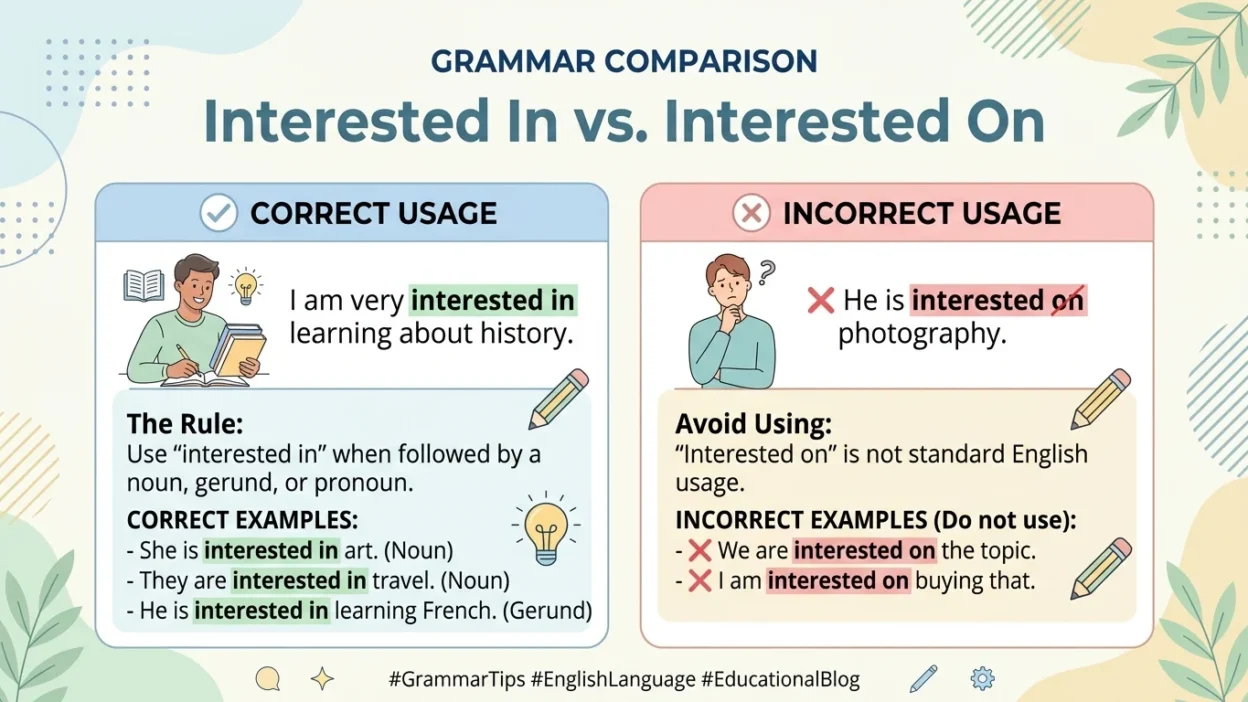
The correct phrase is interested in. The phrase interested on is incorrect in standard English. This guide explains why, with clear rules, examples, and easy tips to help you use it confidently.
Quick Answer: Interested In or Interested On
- Interested in ✅ Correct
- Interested on ❌ Incorrect
- Always use in after “interested”
Example:
- I am interested in music.
- She is interested in learning English.
What Does “Interested In” Mean?
Interested in means liking something, wanting to learn more about it, or being curious or engaged.
You use it when talking about:
- Hobbies
- Topics
- Activities
- Opportunities
- People or ideas
Examples of “Interested In”
- I’m interested in photography.
- She is interested in science.
- They are interested in joining the club.
- He is interested in your idea.
- We are interested in this project.
In all cases, in is the correct preposition.
Why “Interested On” Is Incorrect
Interested on is not used in standard English. It’s a common mistake caused by confusion with other phrases like:
- Focus on
- Work on
- Depend on
But interested does not follow that pattern.
Incorrect:
- I am interested on this topic ❌
Correct:
- I am interested in this topic ✅
Grammar Rule Explained
After certain adjectives (like “interested”), English requires specific prepositions. These combinations are called collocations.
Correct collocation:
- Interested in
You must memorize it because it doesn’t follow a simple rule it’s fixed usage.
Interested In vs Interested On Comparison
| Phrase | Correct? | Usage |
|---|---|---|
| Interested in | ✅ Yes | Standard English |
| Interested on | ❌ No | Incorrect |
Always use interested in.
Common Uses of “Interested In”
1. Talking About Hobbies
- I’m interested in painting.
- She’s interested in sports.
2. Talking About Learning
- He is interested in learning coding.
- They are interested in studying abroad.
3. Talking About Opportunities
- I’m interested in this job.
- She’s interested in the position.
4. Talking About People or Ideas
- He is interested in her work.
- We are interested in your proposal.
Common Mistakes People Make
Mistake 1: Using “On” Instead of “In”
Incorrect: I am interested on this topic.
Correct: I am interested in this topic.
Mistake 2: Translating Directly from Another Language
Some languages use a preposition similar to “on,” which causes confusion.
Mistake 3: Mixing with Other Verbs
Incorrect: I am interested on working here.
Correct: I am interested in working here.
Easy Trick to Remember
Use this simple trick:
👉 Think: IN = inside your interest
If something is inside your interest → use in
Another way:
- You are “involved in” something → so you are interested in it.
Real Life Examples
Everyday Conversation
- I’m interested in movies.
- She’s interested in fashion.
Work Context
- I’m interested in this job role.
- He is interested in the project.
School Context
- She is interested in math.
- They are interested in science.
Emails
- I am interested in your offer.
- We are interested in collaborating.
Similar Expressions
These phrases follow the same pattern:
- Keen on (different structure)
- Fond of
- Excited about
- Curious about
Examples:
- I’m excited about this opportunity.
- She is curious about the topic.
American vs British English
There is no difference between American and British English.
Both use:
- Interested in ✅
- Interested on ❌
Frequently Asked Questions
Is interested on correct?
No. It is incorrect.
Which is correct interested in or on?
Interested in is correct.
Why do we use in after interested?
Because it’s a fixed collocation in English.
Can I ever use interested on?
No, not in standard English.
Is interested in formal or informal?
It works in both formal and informal contexts.
Can I say interested in doing something?
Yes. Example: I’m interested in learning English.
What is a synonym for interested in?
Interested in = curious about, keen on, engaged in.
How do I remember this?
Always pair “interested” with “in.”
Summary:
The difference between interested in or interested on is simple: only interested in is correct. It’s a fixed expression in English used to show curiosity, preference, or engagement with something. Interested on is not grammatically correct and should be avoided in all situations.
To use it correctly, remember that English often relies on set preposition combinations. In this case, “interested” always pairs with “in.” Once you get used to this pattern, it becomes natural and automatic.
Actionable takeaway:
Always use interested in never interested on.