If you’ve ever hesitated between passerbyers, passersby, and passerby, you’re not alone. This word has an unusual plural form that often confuses even advanced English learners.
Here’s the clear answer:
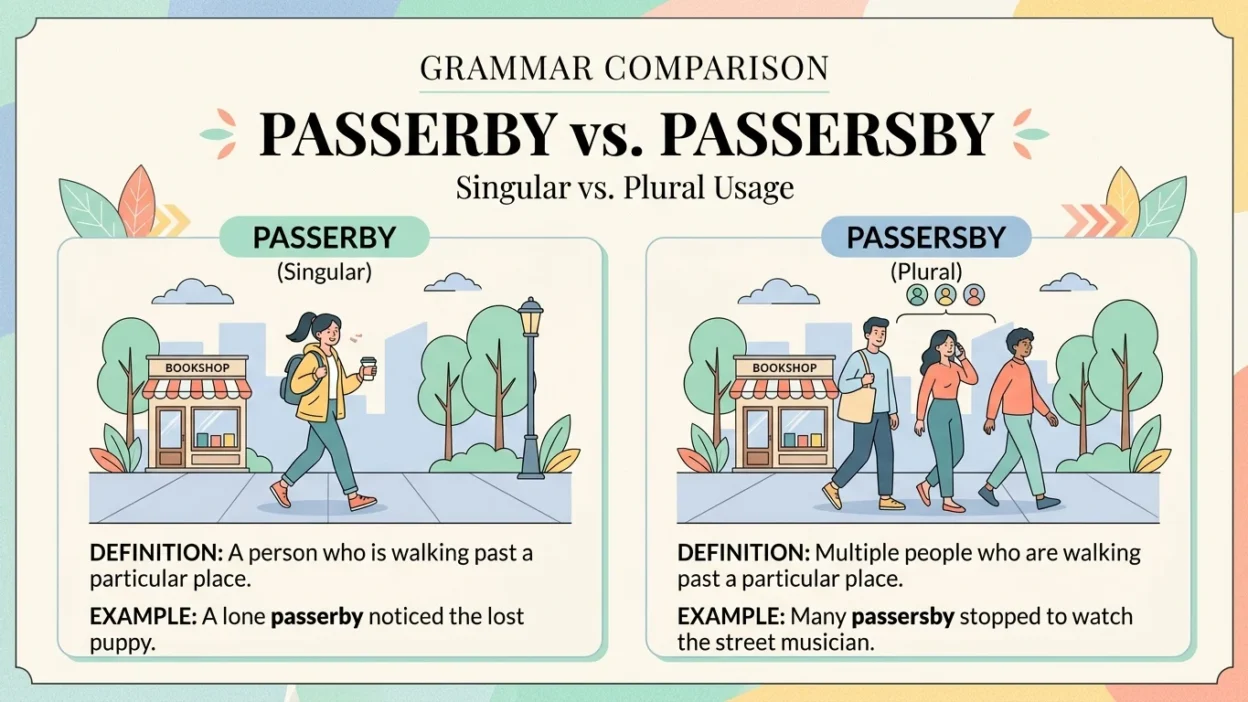
- Passerby = singular
- Passersby = plural
- Passerbyers ❌ incorrect
Let’s break it down so it sticks.
Quick Answer: Passerbyers vs Passersby vs Passerby
- Passerby ✅ one person passing by
- Passersby ✅ more than one person
- Passerbyers ❌ not a real word
Example:
- A passerby helped me.
- Several passersby stopped to watch.
What Does “Passerby” Mean?
A passerby is a person who is walking past a place by chance.
Examples of “Passerby”
- A passerby called for help.
- The passerby didn’t notice the sign.
- One passerby stopped to assist.
What Does “Passersby” Mean?
Passersby is the correct plural form of passerby.
Examples of “Passersby”
- Several passersby saw the accident.
- Curious passersby gathered around.
- Many passersby ignored the noise.
Why “Passerbyers” Is Incorrect
Passerbyers is a common mistake because people try to pluralize the last part of the word. But English doesn’t work that way here.
Correct pluralization happens at the main noun, which is “passer.”
So:
- passer → passers
- by → stays the same
Result:
- passersby ✅
Passerby vs Passersby Comparison
| Form | Correct? | Meaning | Usage |
|---|---|---|---|
| Passerby | ✅ Yes | One person | Singular |
| Passersby | ✅ Yes | Multiple people | Plural |
| Passerbyers | ❌ No | None | Incorrect |
Why This Grammar Is Different
“Passerby” is a compound noun, where:
- “passer” = main noun
- “by” = modifier
In such cases, the plural applies to the main noun, not the end.
Similar examples:
- Mother-in-law → Mothers-in-law
- Attorney general → Attorneys general
Easy Trick to Remember
Use this simple trick:
👉 Focus on the main word: passer
- One → passerby
- Many → passersby
Think:
- “People who pass” → passers
Common Mistakes People Make
Mistake 1: Adding “-ers” at the End
Incorrect: passerbyers ❌
Correct: passersby ✅
Mistake 2: Forgetting the Irregular Plural
Incorrect: many passerby ❌
Correct: many passersby ✅
Mistake 3: Avoiding the Word Completely
Some people avoid using it because it feels confusing—but it’s useful and correct.
Real Life Examples
Everyday Situations
- A passerby offered directions.
- Several passersby watched the street performer.
News Context
- Witnesses included nearby passersby.
- A passerby reported the incident.
Public Places
- Passersby stopped to take photos.
- One passerby asked for help.
American vs British English
There is no difference:
- Passerby ✅
- Passersby ✅
Both forms are used the same way in American and British English.
Frequently Asked Questions
Is passerby singular or plural?
Singular.
What is the plural of passerby?
Passersby.
Is passerbyers correct?
No. It is incorrect.
Why is it passersby and not passerbyers?
Because the plural applies to “passer,” not “by.”
Can I say many passerby?
No. Say many passersby.
Is passersby formal?
It’s standard and used in all contexts.
Are there similar words like this?
Yes, like “mothers in law.”
How do I remember the plural?
Think: passer → passers → passersby
Summary: Passerbyers vs Passersby vs Passerby
The difference between passerbyers, passersby, and passerby is simple once you understand the structure. Passerby is the singular form, passersby is the correct plural, and passerbyers is incorrect. The plural is formed by changing the main noun “passer,” not the ending.
To avoid mistakes, remember this rule: focus on the core word. If there’s more than one person, use passersby. This small grammar rule will help you sound more natural and accurate in English.
Actionable takeaway:
Use passerby for one person and passersby for many never use passerbyers.