If you’re unsure whether to write reevaluation or re evaluation, you’re not alone. Words with prefixes like re often create confusion about spacing and spelling.
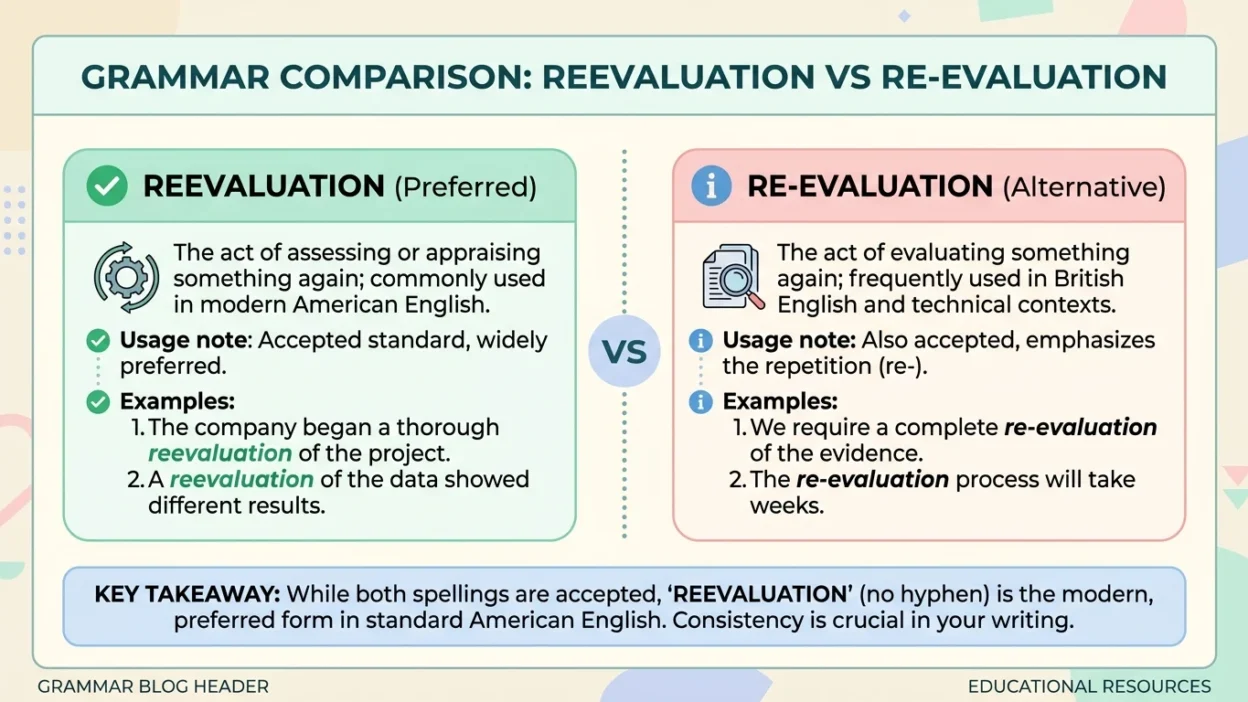
Here’s the simple answer: reevaluation is the correct and standard form, while re evaluation (two words) is incorrect. The hyphenated form re-evaluation is sometimes used, but it’s less common in modern writing.
Quick Answer: Reevaluation or Re Evaluation
- Reevaluation correct and standard
- Re evaluation incorrect
- Re-evaluation acceptable but less common
Example:
- The project needs a reevaluation.
- We scheduled a reevaluation of the plan.
What Does “Reevaluation” Mean?
Reevaluation means evaluating something again or reviewing it to make a new judgment.
Common Uses of Reevaluation
- Reevaluation of a plan
- Reevaluation of a decision
- Performance reevaluation
- Policy reevaluation
Examples of “Reevaluation” in Sentences
- The company ordered a reevaluation of its strategy.
- After feedback, a reevaluation was necessary.
- The teacher did a reevaluation of the test results.
- We need a full reevaluation of the process.
Why “Reevaluation” Is Preferred
Modern English prefers closed compound words like:
- Reuse
- Rebuild
- Reapply
Similarly:
- Reevaluate → Reevaluation
The prefix re joins directly with the base word.
What About “Re Evaluation”
Re evaluation as two separate words is not correct because:
- The prefix re should attach to the word
- Splitting it breaks standard spelling rules
Incorrect:
- We need a re evaluation ❌
Correct:
- We need a reevaluation ✅
When Is “Re Evaluation” Used
In standard writing, it is not used at all. Always avoid it.
What About “Re evaluation”
The hyphenated form re evaluation is:
- Sometimes used for clarity
- Seen in older or more formal writing
- Helpful when avoiding awkward double vowels
Example:
- A re-evaluation may be required.
However, most modern style guides prefer:
- reevaluation without a hyphen
Reevaluation vs Re-evaluation Comparison
| Form | Correct | Usage |
|---|---|---|
| Reevaluation | Yes | Standard modern English |
| Re-evaluation | Yes | Less common, optional |
| Re evaluation | No | Incorrect |
Easy Trick to Remember
Use this simple rule:
👉 Prefix re usually joins the word directly
So:
- reevaluate
- reevaluation
Think:
- Re + evaluation = reevaluation
Common Mistakes People Make
Splitting the Word
Incorrect: re evaluation
Correct: reevaluation
Overusing Hyphens
While re-evaluation is acceptable, it’s not necessary in most cases.
Inconsistent Style
Don’t switch between reevaluation and re evaluation in the same document.
Real Life Examples
Business Context
- The company announced a reevaluation of its goals.
- A full reevaluation is needed.
Academic Context
- The study requires reevaluation.
- After results, a reevaluation was done.
Personal Context
- I did a reevaluation of my priorities.
American vs British English
There is no major difference:
- Reevaluation preferred in both
- Re-evaluation also accepted
Both follow similar usage patterns.
Frequently Asked Questions
Is reevaluation one word
Yes, and it is the standard form.
Is re evaluation correct
No, it is incorrect.
Is re evaluation acceptable
Yes, but less common.
Which form should I use in writing
Use reevaluation.
Why is reevaluation one word
Because the prefix re joins the base word.
Can I use both reevaluation and re evaluation
Yes, but be consistent.
Is reevaluation formal
Yes, it works in all contexts.
Summary:
The difference between reevaluation or re evaluation is simple. Reevaluation is the correct and standard spelling, while re evaluation is incorrect and should be avoided. The hyphenated form re evaluation is acceptable but less commonly used in modern writing.
To keep your writing clean and professional, always use reevaluation. It follows standard prefix rules and is widely accepted across all forms of English.
Actionable takeaway:
Use reevaluation as one word. Avoid re evaluation, and use re evaluation only if needed for clarity.