
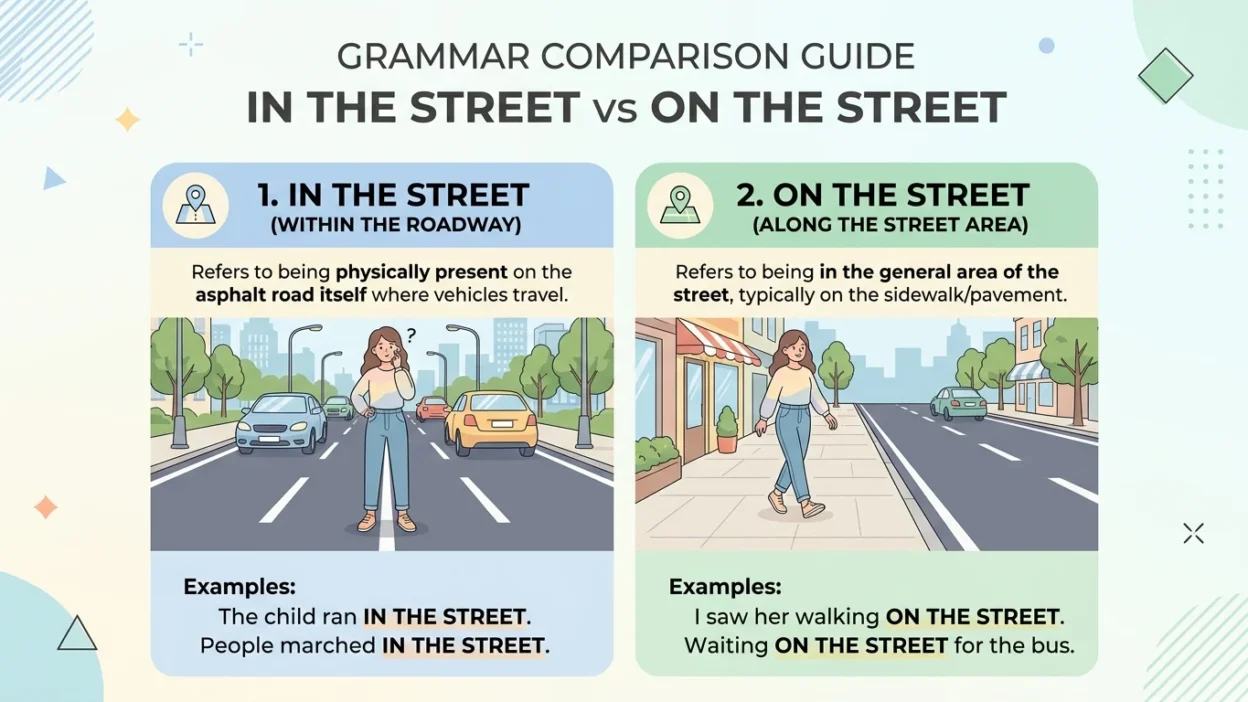
If you’re unsure whether to say in the street or on the street, you’re not alone. Both are correct, but they’re used in different contexts depending on location, region, and meaning.
The key difference is simple: one focuses on being physically within the road space, while the other is more about general location along a street.
Quick Answer: In the Street or On the Street
- On the street → most common, general location
- In the street → inside the roadway, often British usage or specific situations
- Both are correct, but not always interchangeable
Example:
- I live on the street.
- The kids are playing in the street.
What Does “On the Street” Mean?
On the street is the most common and natural phrase, especially in everyday English.
It usually means:
- Located along a street
- At a place connected to a street (house, shop, etc.)
- General position, not necessarily inside the road
Examples of “On the Street”
- I live on the street near the park.
- There’s a café on the street.
- He was walking on the street.
- The store is on the street corner.
Think: On = location along a surface or area
What Does “In the Street” Mean?
In the street means being physically within the street itself, like on the road where cars drive.
It is often used when:
- Emphasizing being inside the roadway
- Talking about activities happening in the road
- In British English more frequently
Examples of “In the Street”
- The children are playing in the street.
- There was water in the street after the rain.
- A car stopped in the street.
Think: In = inside the space
In the Street vs On the Street Comparison
| Phrase | Meaning | Usage |
|---|---|---|
| On the street | General location | Most common |
| In the street | Inside the road | More specific |
Key Difference Explained Simply
- On the street = general location along a street
- In the street = physically inside the roadway
Example:
- She lives on the street → location
- She is standing in the street → inside the road
American vs British English
This is where it gets interesting:
- American English → prefers on the street
- British English → often uses in the street for physical presence
Examples:
- US: He is walking on the street
- UK: He is walking in the street
Both are correct, just different styles.
Common Situations
When to Use “On the Street”
- Talking about addresses
- Describing businesses or homes
- General directions
Example:
- The shop is on the street.
When to Use “In the Street”
- Talking about being in the road
- Describing something happening in traffic space
- Emphasizing physical position
Example:
- The dog ran in the street.
Common Mistakes People Make
Mistake 1: Using “In” for Addresses
Incorrect: I live in the street.
Correct: I live on the street.
Mistake 2: Using “On” for Road Activity
Less clear: Kids are playing on the street
Better: Kids are playing in the street
Easy Trick to Remember
Use this simple trick:
👉 On = location
👉 In = inside the road
Or:
- On → where something is located
- In → where something is happening inside
Real Life Examples
Everyday Use
- I saw him on the street.
- There was water in the street.
Directions
- The bank is on the street next to the store.
Safety Context
- Don’t play in the street.
Similar Expressions
- On the road vs In the road
- On the field vs In the field
- On the beach vs In the water
Frequently Asked Questions
Which is correct in the street or on the street?
Both are correct, depending on context.
What is more common?
On the street is more common.
When should I use in the street?
When something is physically in the road.
Is in the street British English?
It is more common in British usage.
Can I say I live in the street?
No, say on the street.
Which is more natural in American English?
On the street.
Can both be used in the same sentence?
Yes, with different meanings.
How do I remember the difference?
On = location, In = inside
Summary
The difference between in the street or on the street comes down to meaning and context. On the street is the most common and is used for general location, addresses, and directions. In the street is used when something is physically happening within the road itself.
To use them correctly, remember this simple rule: use on the street for location and in the street when something is happening inside the road. This small distinction will make your English clearer and more natural.
Actionable takeaway:
Use on the street for location and in the street for physical position in the road.